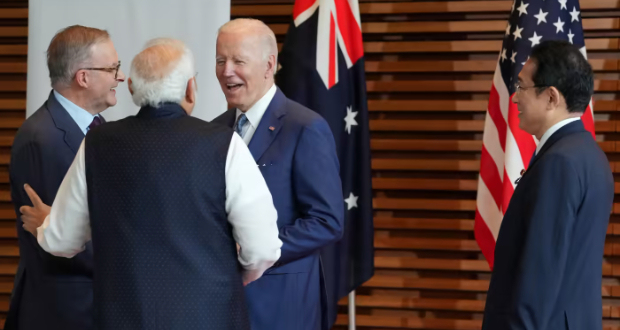
The Quad is at risk of losing its strategic focus
Can the Indo-Pacific region be America's top priority if U.S. President Joe Biden is deepening commitments and resources for Europe and the Middle East? This question is central to the future of the Quad, the strategic coalition of leading Indo-Pacific democracies comprising India, Australia, Japan and the U.S. High-level Quad meetings, like last week's senior officials' gathering in New Delhi, are becoming more frequent. The group's four national leaders alone have held four summit meetings since Biden took office in January 2021. The accelerating tempo of meetings, though, can obscure the fact that the Quad faces important challenges, including establishing a clear strategic mission in the Indo-Pacific region, a sprawling area shaping up as the world's economic and geopolitical hub. The Quad may have been designed to serve as a bulwark against Chinese expansionism, but Biden has coaxed the group into adopting an expansive agenda. To be sure, the Quad has steadily gained strength since it was resurrected in 2017 from a decadelong dormancy. Chinese Foreign Minister Wang Yi famously mocked the Quad in 2018 as a "headline-grabbing idea" that will dissipate "like the sea foam in the Pacific or Indian Oceans." But China's increasingly muscular policies have helped the Quad to build momentum.
India targets net-zero carbon emissions by 2070, says Modi
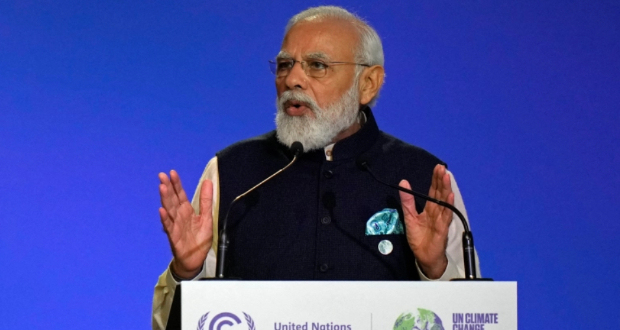
India’s economy will become carbon neutral by the year 2070, the country’s prime minster has announced at the COP26 climate crisis summit in Glasgow. The target date is two decades beyond what scientists say is needed to avert catastrophic climate impacts. India is the last of the world’s major carbon polluters to announce a net-zero target, with China saying it would reach that goal in 2060, and the United States and the European Union aiming for 2050.
COP26: What climate summit means for one woman in Bangladesh

China's carbon emissions are vast and growing, dwarfing those of other countries. Experts agree that without big reductions in China's emissions, the world cannot win the fight against climate change. In 2020, China's President Xi Jinping said his country would aim for its emissions to reach their highest point before 2030 and for carbon neutrality before 2060. His statement has now been confirmed as China's official position ahead of the COP26 global climate summit in Glasgow. But China has not said exactly how these goals will be achieved.
Why China's climate policy matters to us all
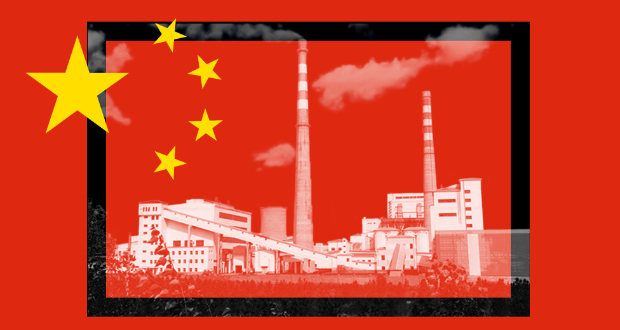
China's carbon emissions are vast and growing, dwarfing those of other countries. Experts agree that without big reductions in China's emissions, the world cannot win the fight against climate change. In 2020, China's President Xi Jinping said his country would aim for its emissions to reach their highest point before 2030 and for carbon neutrality before 2060. His statement has now been confirmed as China's official position ahead of the COP26 global climate summit in Glasgow. But China has not said exactly how these goals will be achieved.
Deliver on promises, developing world tells rich at climate talks

A crucial U.N. conference heard calls on its first day for the world's major economies to keep their promises of financial help to address the climate crisis, while big polluters India and Brazil made new commitments to cut emissions. World leaders, environmental experts and activists all pleaded for decisive action to halt the global warming which threatens the future of the planet at the start of the two-week COP26 summit in the Scottish city of Glasgow on Monday. The task facing negotiators was made even more daunting by the failure of the Group of 20 major industrial nations to agree ambitious new commitments at the weekend.