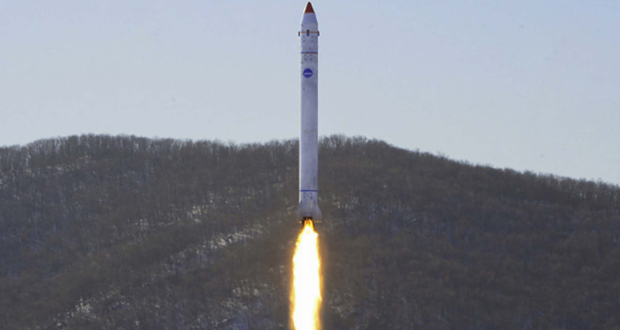
North Korea confirms 'important' spy satellite test for April launch
North Korea's state media KCNA said on Monday the country conducted an "important, final phase" test on Sunday for the development of a spy satellite, which it seeks to complete by April 2023. The report was released a day after the South Korean and Japanese militaries reported the isolated North's launch of two intermediate-range ballistic missiles towards its east coast. Pyongyang's National Aerospace Development Administration (NADA) conducted the test at its Sohae satellite launching station in the northwest to review its capability of satellite imaging, data transmission and ground control systems, according to KCNA. A vehicle carrying a mock satellite, which also included multiple cameras, image transmitters and receivers, a control device and a storage battery, was fired at the "lofted angle" of 500 km (311 miles). "We confirmed important technical indicators such as camera operating technology in the space environment, data processing and transmission ability of the communication devices, tracking and control accuracy of the ground control system," a NADA spokesperson said in the KCNA dispatch.
India targets net-zero carbon emissions by 2070, says Modi
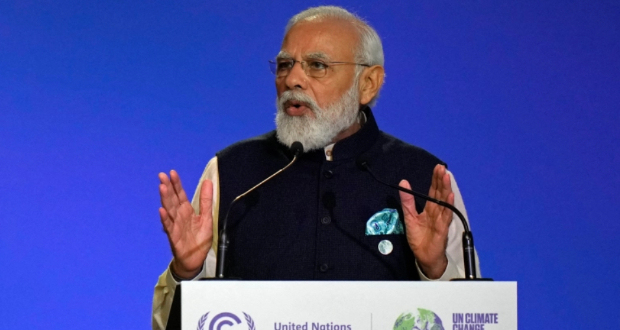
India’s economy will become carbon neutral by the year 2070, the country’s prime minster has announced at the COP26 climate crisis summit in Glasgow. The target date is two decades beyond what scientists say is needed to avert catastrophic climate impacts. India is the last of the world’s major carbon polluters to announce a net-zero target, with China saying it would reach that goal in 2060, and the United States and the European Union aiming for 2050.
COP26: What climate summit means for one woman in Bangladesh

China's carbon emissions are vast and growing, dwarfing those of other countries. Experts agree that without big reductions in China's emissions, the world cannot win the fight against climate change. In 2020, China's President Xi Jinping said his country would aim for its emissions to reach their highest point before 2030 and for carbon neutrality before 2060. His statement has now been confirmed as China's official position ahead of the COP26 global climate summit in Glasgow. But China has not said exactly how these goals will be achieved.
Why China's climate policy matters to us all

China's carbon emissions are vast and growing, dwarfing those of other countries. Experts agree that without big reductions in China's emissions, the world cannot win the fight against climate change. In 2020, China's President Xi Jinping said his country would aim for its emissions to reach their highest point before 2030 and for carbon neutrality before 2060. His statement has now been confirmed as China's official position ahead of the COP26 global climate summit in Glasgow. But China has not said exactly how these goals will be achieved.
Deliver on promises, developing world tells rich at climate talks

A crucial U.N. conference heard calls on its first day for the world's major economies to keep their promises of financial help to address the climate crisis, while big polluters India and Brazil made new commitments to cut emissions. World leaders, environmental experts and activists all pleaded for decisive action to halt the global warming which threatens the future of the planet at the start of the two-week COP26 summit in the Scottish city of Glasgow on Monday. The task facing negotiators was made even more daunting by the failure of the Group of 20 major industrial nations to agree ambitious new commitments at the weekend.