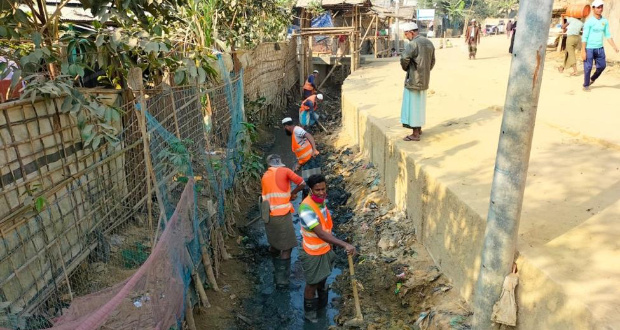
IOM Prepares Rohingya Refugee Camps in Cox's Bazar for Cyclone Mocha
Nearly a million Rohingya refugees in the Cox’s Bazar camps are bracing for Cyclone Mocha, which is expected to hit the region by Sunday Last year, the camps escaped devastation from the Bay of Bengal cyclone Sitrang, which killed 35 people, displaced over 20,000, and caused over USD 35 million in damages in other parts of the country. To help the refugees and local host communities, the International Organization for Migration (IOM) is strengthening camp infrastructure, preparing for medical emergencies, and supporting volunteers in cyclone preparedness. “We have IOM teams and equipment ready to assist government and other humanitarian organizations in clearing the debris to keep key access routes accessible,” said Abdusattor Esoev, IOM Chief of Mission in Bangladesh. Cox’s Bazar is one of the most disaster-prone districts in Bangladesh, vulnerable to cyclones, floods, landslides, and other natural hazards that can cause loss of life and damage vital infrastructure in the camps. The latest cyclone also comes as the camps are still recovering from recent devastating fires that left around 20,000 refugees displaced. IOM and its partners have trained volunteers and equipped health centres with mass casualty kits, mobile medical teams, and ambulances to handle medical emergencies during natural disasters. Over 2,000 volunteers have been trained to respond to cyclones, and 45 multi-purpose cyclone shelters have been made available for emergency evacuation.
India targets net-zero carbon emissions by 2070, says Modi
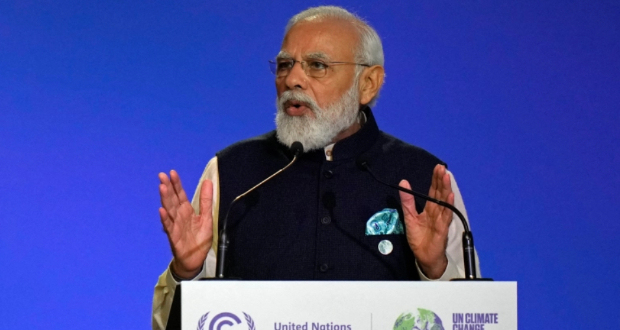
India’s economy will become carbon neutral by the year 2070, the country’s prime minster has announced at the COP26 climate crisis summit in Glasgow. The target date is two decades beyond what scientists say is needed to avert catastrophic climate impacts. India is the last of the world’s major carbon polluters to announce a net-zero target, with China saying it would reach that goal in 2060, and the United States and the European Union aiming for 2050.
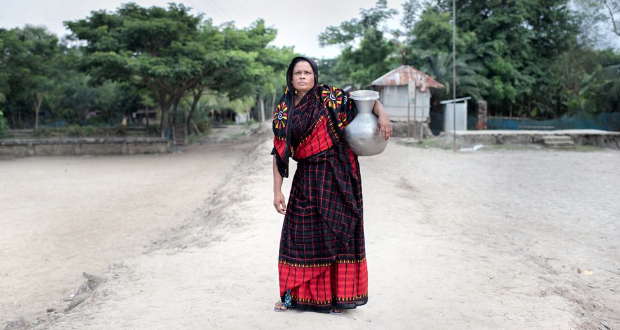
COP26: What climate summit means for one woman in Bangladesh
China's carbon emissions are vast and growing, dwarfing those of other countries. Experts agree that without big reductions in China's emissions, the world cannot win the fight against climate change. In 2020, China's President Xi Jinping said his country would aim for its emissions to reach their highest point before 2030 and for carbon neutrality before 2060. His statement has now been confirmed as China's official position ahead of the COP26 global climate summit in Glasgow. But China has not said exactly how these goals will be achieved.
Why China's climate policy matters to us all
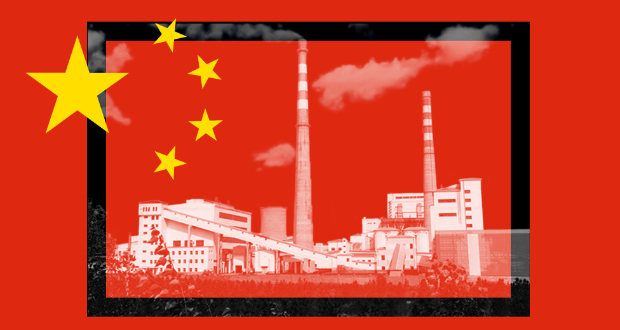
China's carbon emissions are vast and growing, dwarfing those of other countries. Experts agree that without big reductions in China's emissions, the world cannot win the fight against climate change. In 2020, China's President Xi Jinping said his country would aim for its emissions to reach their highest point before 2030 and for carbon neutrality before 2060. His statement has now been confirmed as China's official position ahead of the COP26 global climate summit in Glasgow. But China has not said exactly how these goals will be achieved.
Deliver on promises, developing world tells rich at climate talks

A crucial U.N. conference heard calls on its first day for the world's major economies to keep their promises of financial help to address the climate crisis, while big polluters India and Brazil made new commitments to cut emissions. World leaders, environmental experts and activists all pleaded for decisive action to halt the global warming which threatens the future of the planet at the start of the two-week COP26 summit in the Scottish city of Glasgow on Monday. The task facing negotiators was made even more daunting by the failure of the Group of 20 major industrial nations to agree ambitious new commitments at the weekend.