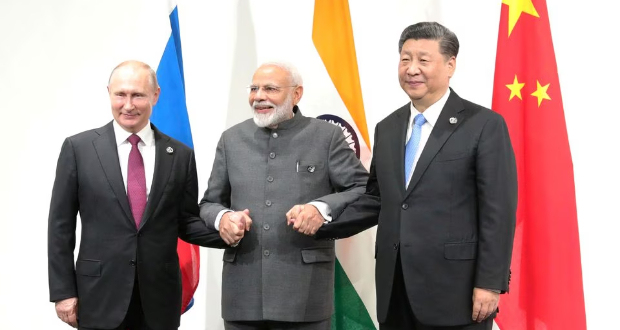
SCO says not against any country as it expands reach, welcomes Iran
Leaders of the Shanghai Cooperation Organisation (SCO) on Tuesday sought to forge closer ties and boost cooperation within the expanding Eurasian bloc but stressed the group is not directed against any other states.
A joint declaration by the leaders at the end of an online summit hosted by India also said SCO members oppose bloc, ideological and confrontational approaches to address problems and security challenges.
The leaders were critical of what they said was the negative impact of "unilateral and unlimited expansion of global missile defence systems by certain countries or groups of countries", without directly referring to NATO's expansion and Western military assistance to Ukraine.
Expressing concern about the situation in Afghanistan, the leaders said they consider "it essential to establish an inclusive government in Afghanistan with the participation of representatives of all ethnic, religious and political groups in Afghan society”.
All members bar India also supported China's vast Belt and Road Initiative (BRI) scheme which envisions rebuilding the old Silk Road to connect China with Asia, Europe and beyond with large infrastructure spending.
A Eurasian security and political group formed in 2001 by Beijing and Moscow, SCO includes India, Pakistan, Kazakhstan, the Kyrgyz Republic, Tajikistan and Uzbekistan.
Iran joined the grouping on Tuesday, becoming its ninth member with President Ebrahim Raisi taking part in the proceedings.
Belarus signed a memorandum of obligations which will lead to its membership in 2024, adding heft to the bloc as it seeks to expand its reach and counter Western influence in the region - a sentiment that was more pronounced in the individual remarks of China and Russia.
PUTIN'S REASSURANCE
The virtual summit saw Russia's President Vladimir Putin making his first appearance at an international forum since a short-lived mutiny last month and reassuring SCO leaders of Russia's stability and unity.
Putin warned that the potential for conflicts and the risk of a global economic crisis were on the rise. He also said Moscow planned to boost ties with the SCO.
He told the summit that Russia would stand up against Western pressure, sanctions and "provocations" imposed over what Moscow calls its "special military operation" in Ukraine.
India targets net-zero carbon emissions by 2070, says Modi
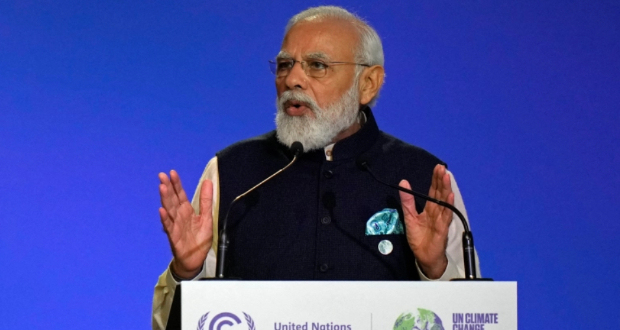
India’s economy will become carbon neutral by the year 2070, the country’s prime minster has announced at the COP26 climate crisis summit in Glasgow. The target date is two decades beyond what scientists say is needed to avert catastrophic climate impacts. India is the last of the world’s major carbon polluters to announce a net-zero target, with China saying it would reach that goal in 2060, and the United States and the European Union aiming for 2050.
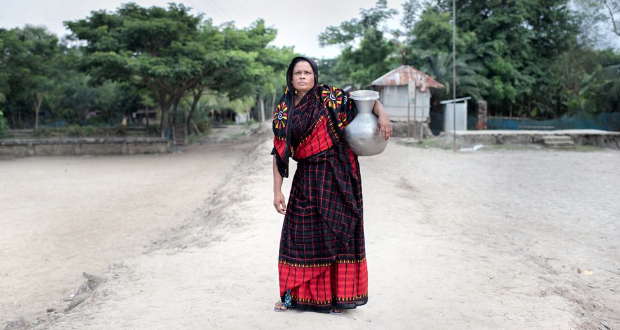
COP26: What climate summit means for one woman in Bangladesh
China's carbon emissions are vast and growing, dwarfing those of other countries. Experts agree that without big reductions in China's emissions, the world cannot win the fight against climate change. In 2020, China's President Xi Jinping said his country would aim for its emissions to reach their highest point before 2030 and for carbon neutrality before 2060. His statement has now been confirmed as China's official position ahead of the COP26 global climate summit in Glasgow. But China has not said exactly how these goals will be achieved.
Why China's climate policy matters to us all
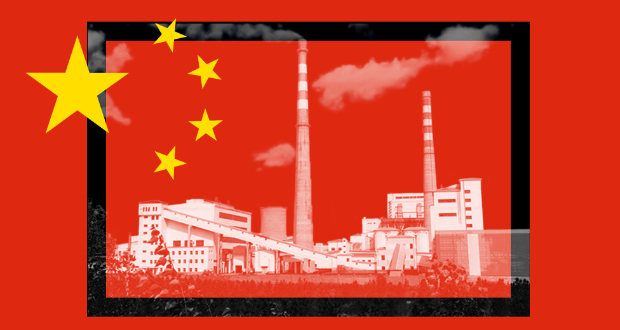
China's carbon emissions are vast and growing, dwarfing those of other countries. Experts agree that without big reductions in China's emissions, the world cannot win the fight against climate change. In 2020, China's President Xi Jinping said his country would aim for its emissions to reach their highest point before 2030 and for carbon neutrality before 2060. His statement has now been confirmed as China's official position ahead of the COP26 global climate summit in Glasgow. But China has not said exactly how these goals will be achieved.
Deliver on promises, developing world tells rich at climate talks

A crucial U.N. conference heard calls on its first day for the world's major economies to keep their promises of financial help to address the climate crisis, while big polluters India and Brazil made new commitments to cut emissions. World leaders, environmental experts and activists all pleaded for decisive action to halt the global warming which threatens the future of the planet at the start of the two-week COP26 summit in the Scottish city of Glasgow on Monday. The task facing negotiators was made even more daunting by the failure of the Group of 20 major industrial nations to agree ambitious new commitments at the weekend.