Russia’s Medvedev says NATO’s Ukraine aid brings world war closer

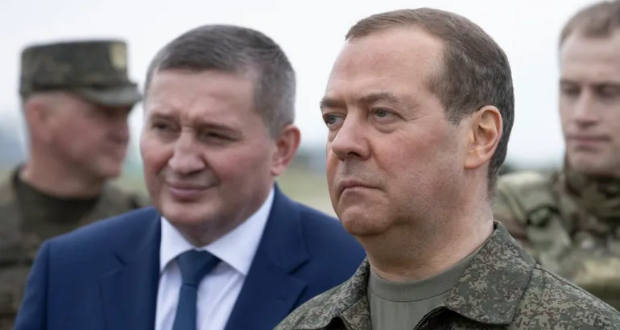
Increased assistance for Ukraine from NATO members brings the threat of a third global conflict closer, Russia’s Dmitry Medvedev, the deputy secretary of the Kremlin’s powerful Security Council, has warned.


Commenting late on Tuesday as the first day of the NATO summit in Lithuania wrapped up, Medvedev said that pledges of military aid from the Western defence alliance to Kyiv would not deter Russia from achieving its goals in Ukraine. Russia’s foreign minister issued similar warnings that Moscow had no intention to end its war.

“The completely crazy West could not come up with anything else … In fact, it’s a dead end. World War Three is getting closer,” Medvedev wrote on the Telegram messaging app.

“What does all this mean for us? Everything is obvious. The special military operation will continue with the same goals,” he said, using the official Russian name for its full-scale invasion of Ukraine.

Medvedev, who had cast himself as a liberal moderniser when he was Russian president from 2008-2012, has more recently presented as a fiercely anti-Western Kremlin hawk. In January, he threatened that defeat in a conventional war in Ukraine could lead to a nuclear war. Diplomats say his views give an indication of thinking at the top levels of the Kremlin elite.

According to Russia’s state-run TASS news agency, Medvedev also said that Moscow’s goal of preventing the “neo-Nazi group” in Kyiv from joining NATO was now “impossible” and removing the Ukrainian government was necessary.
Read Full Article:

Share This Article

Related Articles

India targets net-zero carbon emissions by 2070, says Modi

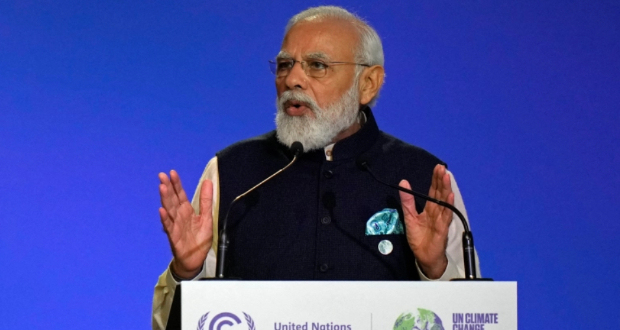
India’s economy will become carbon neutral by the year 2070, the country’s prime minster has announced at the COP26 climate crisis summit in Glasgow. The target date is two decades beyond what scientists say is needed to avert catastrophic climate impacts. India is the last of the world’s major carbon polluters to announce a net-zero target, with China saying it would reach that goal in 2060, and the United States and the European Union aiming for 2050.

COP26: What climate summit means for one woman in Bangladesh

China's carbon emissions are vast and growing, dwarfing those of other countries. Experts agree that without big reductions in China's emissions, the world cannot win the fight against climate change. In 2020, China's President Xi Jinping said his country would aim for its emissions to reach their highest point before 2030 and for carbon neutrality before 2060. His statement has now been confirmed as China's official position ahead of the COP26 global climate summit in Glasgow. But China has not said exactly how these goals will be achieved.

Why China's climate policy matters to us all

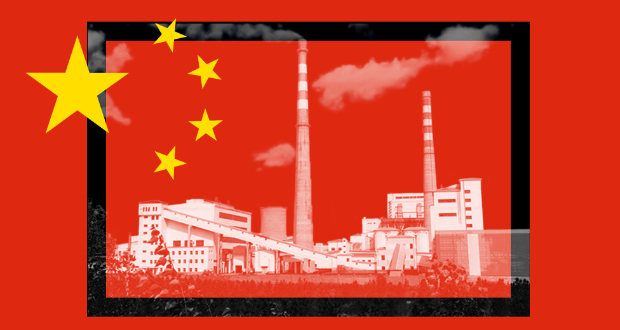
China's carbon emissions are vast and growing, dwarfing those of other countries. Experts agree that without big reductions in China's emissions, the world cannot win the fight against climate change. In 2020, China's President Xi Jinping said his country would aim for its emissions to reach their highest point before 2030 and for carbon neutrality before 2060. His statement has now been confirmed as China's official position ahead of the COP26 global climate summit in Glasgow. But China has not said exactly how these goals will be achieved.

Deliver on promises, developing world tells rich at climate talks

A crucial U.N. conference heard calls on its first day for the world's major economies to keep their promises of financial help to address the climate crisis, while big polluters India and Brazil made new commitments to cut emissions. World leaders, environmental experts and activists all pleaded for decisive action to halt the global warming which threatens the future of the planet at the start of the two-week COP26 summit in the Scottish city of Glasgow on Monday. The task facing negotiators was made even more daunting by the failure of the Group of 20 major industrial nations to agree ambitious new commitments at the weekend.