PM to open South Asia's largest single STP in Dhaka today

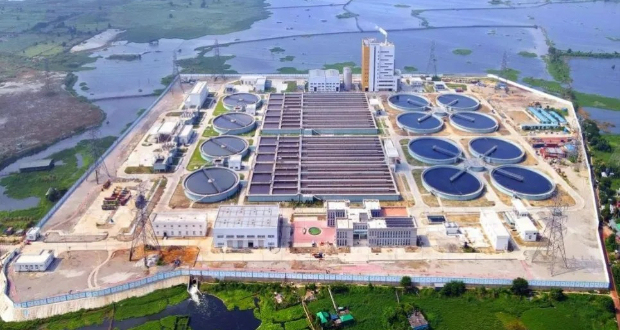
Prime Minister Sheikh Hasina will inaugurate the South Asia's largest single sewage treatment plant (STP), having a capacity of treating 5 million sewage per day, in the city's Khilgaon area on Thursday, which will save the rivers surrounding the capital from pollution.


 "The Prime Minister will formally commission operation of the Dasherkandi Sewage Treatment Plant in Dhaka, first of its kind in the country on Thursday," said Dhaka Water Supply and Sewerage Authority (WASA) Managing Director Taqsem A Khan.

Briefing newsmen about the plant at its office site in Dhaka's Aftabnagar on Tuesday, he said the plant has the capacity of treating 5 million metric tons of sewage everyday which is 20 to 25 percent of the total sewage, weighing 2000 million metric tons, in the capital city.

The Dhaka WASA chief said they will build four more sewage treatment plants, one each in Pagla, Uttara, Rayerbazar and Mirpur areas in accordance with a master plan to treat 100 percent sewage of Dhaka by 2030, 90 percent of which through pipeline coverage and remaining 10 percent collecting from houses.

The plant helps implementing SDG Goal-6 by ensuring better waste management system across the country by 2030, he said, adding that Prime Minister Sheikh Hasina is the pioneer of bringing the country under a proper waste management system.

"Such kind of single sewage treatment plant is nowhere in the South Asia and it is the largest one in the region. This is the best one," he said.

Taqsem said the plant is environment friendly, sustainable and people friendly.

"Treated water from sewage is falling into the water of Balu river which increase the quality of the river water and the water is as good as drinkable. It is possible to drink the water by treating that further," he said.

The land acquisition for the Pagla Sewage Treatment Plant has already been completed while the process to acquire land for Rayerbazar is almost complete.

The Dhaka WASA boss said the fly ashes, by-product of the sewage, will be sold to the cement factories as those are required to produce cement, he said, adding that three cement factories are now taking the fly ashes on experimental basis and formal agreements will later be signed with them.

He said Dhaka WASA has digitized 70 percent of its activities in line with the government's initiative to make Bangladesh Digital.

The Padma and Sayedabad Treatment plants have been made fully automated.

"We are companion of the government in its journey towards the highway of development," he said.

Project Director Md Mohsin Ali Miah and Prime Minister's Deputy Press Secretary Hasan Jahid Tusher were present during the briefing.

The Dasherkandi Treatment Plant, which falls within Khilgaon Police Station, is adjacent to Aftabnagar and will treat sewage of several areas of the capital, including Gulshan( part), Banani, Tejgaon, Niketon, Maghbazar, Malibah, Aftabnagar, Badda, Kalabagan, Panthapath, Dhanmondi (part) and Hatirjheel.
Read Full Article:

Share This Article

Related Articles

India targets net-zero carbon emissions by 2070, says Modi

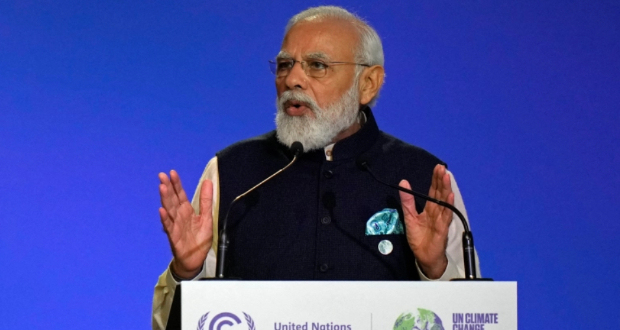
India’s economy will become carbon neutral by the year 2070, the country’s prime minster has announced at the COP26 climate crisis summit in Glasgow. The target date is two decades beyond what scientists say is needed to avert catastrophic climate impacts. India is the last of the world’s major carbon polluters to announce a net-zero target, with China saying it would reach that goal in 2060, and the United States and the European Union aiming for 2050.

COP26: What climate summit means for one woman in Bangladesh

China's carbon emissions are vast and growing, dwarfing those of other countries. Experts agree that without big reductions in China's emissions, the world cannot win the fight against climate change. In 2020, China's President Xi Jinping said his country would aim for its emissions to reach their highest point before 2030 and for carbon neutrality before 2060. His statement has now been confirmed as China's official position ahead of the COP26 global climate summit in Glasgow. But China has not said exactly how these goals will be achieved.

Why China's climate policy matters to us all

China's carbon emissions are vast and growing, dwarfing those of other countries. Experts agree that without big reductions in China's emissions, the world cannot win the fight against climate change. In 2020, China's President Xi Jinping said his country would aim for its emissions to reach their highest point before 2030 and for carbon neutrality before 2060. His statement has now been confirmed as China's official position ahead of the COP26 global climate summit in Glasgow. But China has not said exactly how these goals will be achieved.

Deliver on promises, developing world tells rich at climate talks

A crucial U.N. conference heard calls on its first day for the world's major economies to keep their promises of financial help to address the climate crisis, while big polluters India and Brazil made new commitments to cut emissions. World leaders, environmental experts and activists all pleaded for decisive action to halt the global warming which threatens the future of the planet at the start of the two-week COP26 summit in the Scottish city of Glasgow on Monday. The task facing negotiators was made even more daunting by the failure of the Group of 20 major industrial nations to agree ambitious new commitments at the weekend.