There are some hard questions to be asked at AUSMIN

The Americans say that this year’s Australia-US Ministerial Consultations (AUSMIN) are unlikely to herald any razzle-dazzle announcements.


According to the US State Department, there is no “specific deliverable in mind” likely to emerge from the discussions in Brisbane this Saturday between the Australian foreign and defence ministers and their American counterparts.
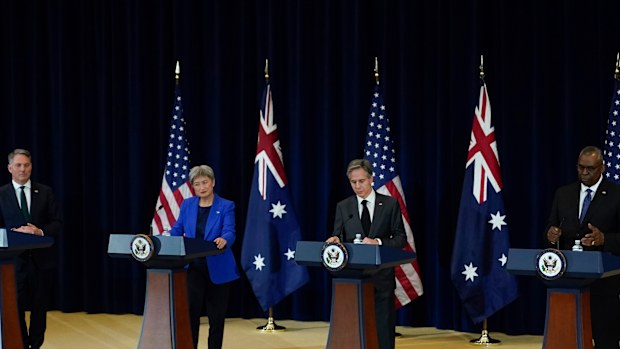
This week’s AUSMIN talks come as the US Congress asks more tough questions about the sale of US nuclear-powered submarines to Australia. AP

The big-ticket items are being reserved for Prime Minister Anthony Albanese’s state visit to Washington, possibly in November.

But AUSMIN 2023 remains a critical moment to exchange views on the regional and world situation.

While US “unpredictability” is a watchword, Washington has still marshalled much of the western effort to defend Ukraine. And as recent visits to China by Antony Blinken, Janet Yellen and John Kerry show, America retains an appetite for dialogue with Beijing. US officials have been more vocal than the Chinese in wanting guardrails in an increasingly tense relationship.

Canberra hopes that President Joe Biden wins next year, but the two sides might also discuss mutual apprehension over elections in Taipei and Jakarta in 2024, Japanese ambivalence over going to war with China over Taiwan, and South Korea’s desire to join the Quad.

It is often stated that Australia is now more important to America than ever. Sure, but how is Canberra using this intimacy to gain new leverage?

Labor is tentative. Last December, Foreign Minister Penny Wong pressed the Americans to increase their regional economic footprint, aware that its Indo-Pacific Economic Framework is anaemic. Moreover, she reminded them of the architecture of restraint that prevented the unthinkable in the Cuban missile crisis of October 1962.

But America now is also more demanding of Australia, and it is unclear what Canberra’s thinking on this is. The United States is uninterested in being a mere balancing power in Asia – reaching some kind of modus vivendi with China and allowing a more stable multipolar system to develop. Its exceptionalism will not contemplate this alternative to primacy.

Read Full Article: 

Share This Article

Related Articles

India targets net-zero carbon emissions by 2070, says Modi

India’s economy will become carbon neutral by the year 2070, the country’s prime minster has announced at the COP26 climate crisis summit in Glasgow. The target date is two decades beyond what scientists say is needed to avert catastrophic climate impacts. India is the last of the world’s major carbon polluters to announce a net-zero target, with China saying it would reach that goal in 2060, and the United States and the European Union aiming for 2050.

COP26: What climate summit means for one woman in Bangladesh

China's carbon emissions are vast and growing, dwarfing those of other countries. Experts agree that without big reductions in China's emissions, the world cannot win the fight against climate change. In 2020, China's President Xi Jinping said his country would aim for its emissions to reach their highest point before 2030 and for carbon neutrality before 2060. His statement has now been confirmed as China's official position ahead of the COP26 global climate summit in Glasgow. But China has not said exactly how these goals will be achieved.

Why China's climate policy matters to us all

China's carbon emissions are vast and growing, dwarfing those of other countries. Experts agree that without big reductions in China's emissions, the world cannot win the fight against climate change. In 2020, China's President Xi Jinping said his country would aim for its emissions to reach their highest point before 2030 and for carbon neutrality before 2060. His statement has now been confirmed as China's official position ahead of the COP26 global climate summit in Glasgow. But China has not said exactly how these goals will be achieved.

Deliver on promises, developing world tells rich at climate talks

A crucial U.N. conference heard calls on its first day for the world's major economies to keep their promises of financial help to address the climate crisis, while big polluters India and Brazil made new commitments to cut emissions. World leaders, environmental experts and activists all pleaded for decisive action to halt the global warming which threatens the future of the planet at the start of the two-week COP26 summit in the Scottish city of Glasgow on Monday. The task facing negotiators was made even more daunting by the failure of the Group of 20 major industrial nations to agree ambitious new commitments at the weekend.