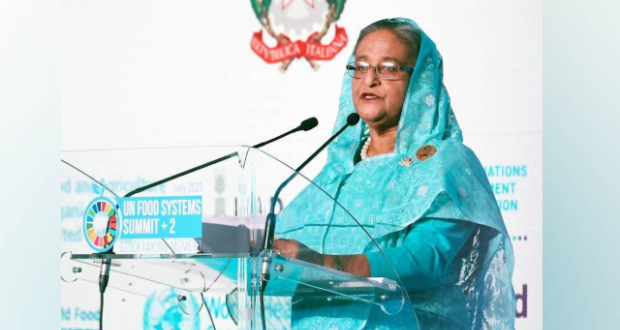
Prime Minister Sheikh Hasina on Monday called upon the international community to consider transforming the food system a priority for climate financing by the developed countries.
“Transforming food systems should be considered a priority for climate financing by developed countries, with due attention to climate-adaptive agri-food systems,” she said addressing a plenary session of the UN Food Systems Summit+2 Stocktaking Moment (UNFSS+2) here in Italy.
This was the first of the five proposals the premier made in the plenary session on Food Systems and Climate Action held at the headquarters of Food and Agriculture Organization (FAO) of the United Nations in Rome.
In her second proposal she said: “The UN Food System Coordination Hub needs to scale up knowledge-management by promoting interdisciplinary collaboration in research and innovations.”
Placing the third proposal, Sheikh Hasina said: “The private sector needs to be actively engaged in promoting climate-positive solutions to food and fertilizer needs in low and middle-income countries.”
She, in her 4th and 5th proposals, said: “International partnership needs to be strengthened for using effective agri-food technologies in climate hotspots like deltas and coastal zones; and we need to activate the Coalition for Climate-Resilient Food Systems that Bangladesh agreed to co-lead during the UN Food Systems Summit in 2021.”
PM Hasina said the climate crisis requires the world to work on a sustainable and transformed food system. “We must identify what needs to be done without further delay. Food security is now related to climate justice,” she said.
She said the world witnesses increased temperatures, prolonged droughts, massive floods and variable rainfalls in different parts of the world. “In Bangladesh, our coastal lands are experiencing sea level rise and salinity intrusion with adverse effects on rice production. We also see decline in arable land every year due to river erosion, urbanization, industrial growth and other factors,” she said.
Sheikh Hasina said the modern agri-food supply chain has emerged as one of the biggest contributors to global greenhouse gas emissions. “We should invest in making food production, processing, consumption and disposal climate-neutral. We need sufficient political will and international public opinion for the purpose,” she said.
She said Bangladesh has recently joined the Global Methane Pledge. “We hope to see the main sponsors of the initiative come up with the financial and technical assistance that they committed,” she said.
The prime minister said her government is following the developments around the proposed International Bio-fuels Alliance by G20. “We are encouraging the use of solar power for irrigation even by our small holder farmers. We need access to cost-effective technologies for precision agriculture, low-emission livestock and waste management,” she said.
“I invite foreign investment for sustainable deep-sea fishing in our maritime areas in the Bay of Bengal,” said the Bangladesh premier.
She said immediately after our independence in 1971, Bangladesh's Father of the Nation Bangabandhu Sheikh Mujibur Rahman, called for a “Green Revolution”. “The time has come again for a climate-smart “Agri-Food Revolution”. We need to apply both nature-positive solutions and advanced technologies to transform the sector,” she said.
With the hard-earned gains in agriculture and food production, Bangladesh is uniquely placed to lead the global agenda on this, she said, adding that the COP 28 President-designate invited her last week to personally champion the issue.
“In Bangladesh, our agricultural scientists and extension officials are working together with our farmers to develop climate-resilient agri-food solutions. Our government has significantly increased the budget and capacity of our agricultural universities and research institutes,” said the PM Hasina.
A total of 690 improved and high-yielding crop varieties have been developed or introduced in the last 14 years. Among the stress-tolerant rice varieties, there are 14 resistant to salinity, six to water submergence, 10 to drought, four to cold weather, and seven of prime quality, she said.