Under the new controls, special licences will be needed to export gallium and germanium from the world's second largest economy.
The materials are used to produce chips and have military applications.
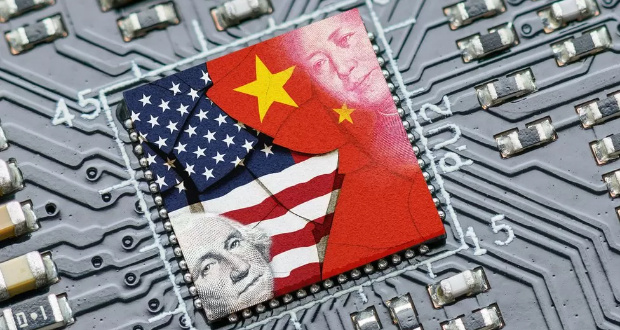
The curbs come after Washington made efforts to limit Beijing's access to advanced microprocessor technology.
China is by far the biggest player in the global supply chain of gallium and germanium. It produces 80% of the world's gallium and 60% of germanium, according to the Critical Raw Materials Alliance (CRMA) industry body.
The materials are "minor metals", meaning that they are not usually found on their own in nature, and are often the by-product of other processes.
Besides the US, both Japan and the Netherlands - which is home to key chip equipment maker ASML - have imposed chip technology export restrictions on China.
"The timing of this announcement from China is not coincidental, given chip export restrictions announced by the Netherlands amongst others," Colin Hamilton from the investment firm BMO Capital Markets told the BBC.
"Quite simply, if you won't give us chips, we won't give you the materials to make those chips," he added.
The constant tit-for-tat between the world's two biggest economies has raised concerns over the rise of so-called "resource nationalism" - when governments hoard critical materials to exert influence over other countries.
"We're seeing governments increasingly move away from the narrative of globalisation," says Dr Gavin Harper, a critical materials research fellow at the University of Birmingham.
"The idea that international markets will simply deliver materials is gone and, if you look at the picture more broadly, Western industry could be facing a bit of an existential threat."