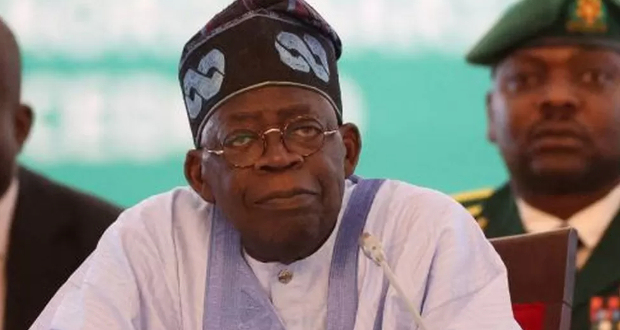
Nigeria's President Tinubu faces backlash over military intervention in Niger

Nigeria's President Bola Tinubu is facing a huge backlash at home over his threat to use military force to reverse the coup in next-door neighbour Niger.

Local media report there was strong opposition to military intervention at a session of the upper chamber of parliament, the Senate, on Saturday, despite the fact that it is controlled by Mr Tinubu's party.

This was especially the case among lawmakers representing states along the more than 1,500km (930 mile)-long border with Niger, but there has also been countrywide condemnation of the possibility of war.

West African regional bloc Ecowas had set a deadline of Sunday for the junta to give up power - or face possible military action.

The decision was very much seen as Mr Tinubu's as he is Ecowas' current chairman, and Nigeria is its most influential member.

Although the junta has defied the ultimatum, Ecowas did not respond by immediately sending troops. This came as a relief to many Nigerians who prefer a diplomatic resolution to the crisis.

Some question whether a seven-day deadline was realistic given that Nigeria and other countries have to get parliamentary approval before deploying the military.

Many people are also appalled that electricity to Niger was cut on President Tinubu's orders, causing blackouts in Niger's capital, Niamey, and other cities.

Critics claim that this is in violation of a treaty that had enabled Nigeria to build a dam on the River Niger, though Mr Tinubu's supporters say the power cuts are aimed at pressuring the junta to hand back power to ousted President Mohamed Bazoum, without military confrontation.

Nigeria and Niger share strong ethnic, economic and cultural ties and any military intervention against Niger would affect northern Nigeria, already facing serious security challenges of its own.

An influential group of Muslim clerics in northern Nigeria said Mr Tinubu must not "rush into an avoidable conflict with a neighbour at the behest of global politicking".
Read Full Article:

Share This Article

Related Articles

India targets net-zero carbon emissions by 2070, says Modi

India’s economy will become carbon neutral by the year 2070, the country’s prime minster has announced at the COP26 climate crisis summit in Glasgow. The target date is two decades beyond what scientists say is needed to avert catastrophic climate impacts. India is the last of the world’s major carbon polluters to announce a net-zero target, with China saying it would reach that goal in 2060, and the United States and the European Union aiming for 2050.

COP26: What climate summit means for one woman in Bangladesh

China's carbon emissions are vast and growing, dwarfing those of other countries. Experts agree that without big reductions in China's emissions, the world cannot win the fight against climate change. In 2020, China's President Xi Jinping said his country would aim for its emissions to reach their highest point before 2030 and for carbon neutrality before 2060. His statement has now been confirmed as China's official position ahead of the COP26 global climate summit in Glasgow. But China has not said exactly how these goals will be achieved.

Why China's climate policy matters to us all

China's carbon emissions are vast and growing, dwarfing those of other countries. Experts agree that without big reductions in China's emissions, the world cannot win the fight against climate change. In 2020, China's President Xi Jinping said his country would aim for its emissions to reach their highest point before 2030 and for carbon neutrality before 2060. His statement has now been confirmed as China's official position ahead of the COP26 global climate summit in Glasgow. But China has not said exactly how these goals will be achieved.

Deliver on promises, developing world tells rich at climate talks

A crucial U.N. conference heard calls on its first day for the world's major economies to keep their promises of financial help to address the climate crisis, while big polluters India and Brazil made new commitments to cut emissions. World leaders, environmental experts and activists all pleaded for decisive action to halt the global warming which threatens the future of the planet at the start of the two-week COP26 summit in the Scottish city of Glasgow on Monday. The task facing negotiators was made even more daunting by the failure of the Group of 20 major industrial nations to agree ambitious new commitments at the weekend.