
IRI survey: Majority in Bangladesh think PM Hasina doing good job
An overwhelming majority of 70% respondents believe that Prime Minister Sheikh Hasina is doing a “good job,” according to the Washington-based International Republican Institute (IRI)
This is 4% more than the survey conducted by the same institution in 2018.
IRI is an American nonprofit organization funded and supported by the United States federal government. Most of its board are drawn from the Republican Party.
The survey was conducted between March and April. The results are posted on the IRI website.
The survey results come ahead of the national elections to be held by January next year. The ruling Awami League and the BNP party are at loggerheads over the election-time government, as the government says it would be held as per the constitution while the opposition demands a caretaker government system.
Some 55% believe that opposition parties should participate in the coming polls even in absence of a caretaker government, according to the survey.
Analysts believe the rise in the approval rate of Prime Minister Hasina in a span of five years validates her successful Covid management, a raft of infrastructure projects, and the rolling out of a number of safety net schemes.
On the government’s performance in different sectors, the endorsement for Awami League also stood “high”.
A staggering 87% (strongly and somewhat) approve of the role of the government in the developments of roads, highways and bridges, while 86% approve of the work of the government in ensuring availability of drinking water.
On ensuring availability of electricity, 84% endorsed the role of the government. Furthermore, 77% approved of the efforts put in by the government in driving quality healthcare.
A total of 81% endorsed the performance of the government in improving education, while 54% contended that the government’s fight against violent extremism was a success and 60% approved of the initiatives by the government in keeping the peace.
India targets net-zero carbon emissions by 2070, says Modi
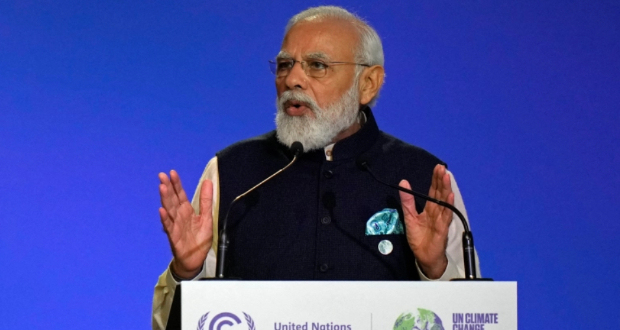
India’s economy will become carbon neutral by the year 2070, the country’s prime minster has announced at the COP26 climate crisis summit in Glasgow. The target date is two decades beyond what scientists say is needed to avert catastrophic climate impacts. India is the last of the world’s major carbon polluters to announce a net-zero target, with China saying it would reach that goal in 2060, and the United States and the European Union aiming for 2050.
COP26: What climate summit means for one woman in Bangladesh

China's carbon emissions are vast and growing, dwarfing those of other countries. Experts agree that without big reductions in China's emissions, the world cannot win the fight against climate change. In 2020, China's President Xi Jinping said his country would aim for its emissions to reach their highest point before 2030 and for carbon neutrality before 2060. His statement has now been confirmed as China's official position ahead of the COP26 global climate summit in Glasgow. But China has not said exactly how these goals will be achieved.
Why China's climate policy matters to us all

China's carbon emissions are vast and growing, dwarfing those of other countries. Experts agree that without big reductions in China's emissions, the world cannot win the fight against climate change. In 2020, China's President Xi Jinping said his country would aim for its emissions to reach their highest point before 2030 and for carbon neutrality before 2060. His statement has now been confirmed as China's official position ahead of the COP26 global climate summit in Glasgow. But China has not said exactly how these goals will be achieved.
Deliver on promises, developing world tells rich at climate talks

A crucial U.N. conference heard calls on its first day for the world's major economies to keep their promises of financial help to address the climate crisis, while big polluters India and Brazil made new commitments to cut emissions. World leaders, environmental experts and activists all pleaded for decisive action to halt the global warming which threatens the future of the planet at the start of the two-week COP26 summit in the Scottish city of Glasgow on Monday. The task facing negotiators was made even more daunting by the failure of the Group of 20 major industrial nations to agree ambitious new commitments at the weekend.