US-Japan-S Korea summit a coup for Biden but will détente last?
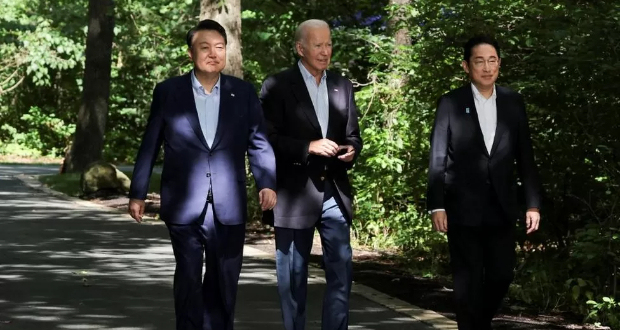
The United States and China have achieved what many deemed impossible - a historic meeting between US President Joe Biden, Japan's Prime Minister Fumio Kishida and South Korea's President Yoon Suk-yeol.
Mr Biden hosted the first stand-alone meeting among the three countries at the Camp David presidential retreat in the US on Friday. It's a diplomatic - but still tenuous - coup for the American leader.
South Korea and Japan are neighbours and old US allies, but they have never been friends.
Now, however, an increasingly assertive China has renewed US interest in East Asia. And it has brought together two countries who for decades have struggled to overcome deep historical grievances.
Speaking ahead of the meeting, Mr Biden praised the "political courage" of the South Korean and Japanese leaders.
"Our countries are stronger, and the world will be safer, as we stand together. I know that's a belief that we all three share," he said, while Mr Yoon said it was a "historic day".
In a joint statement, they said they opposed China's "dangerous and aggressive behaviour" in maritime disputes in the East and South China Seas.
They also agreed to hold regular joint exercises, consult each other during crises, share real-time data on North Korea and hold summits every year.
"I find the meeting at Camp David mind-blowing," Dennis Wilder wrote on X, formerly Twitter. A professor at Georgetown University, he managed the Japan and South Korea relationship under former President George W Bush.
At that time, they could "barely get South Korean and Japanese leaders to meet with us in the same room," he said.
In recent months, Mr Kishida and Mr Yoon have taken tentative steps to resolve their hostilities, and strengthen ties with Washington. This once-inconceivable alliance is driven by shared concerns - the biggest of which is China.
The meeting at Camp David - also the first time foreign leaders have visited the presidential retreat since 2015 - is an attempt to "signify and to demonstrate how seriously" Mr Biden takes the relationship between Japan and South Korea, according to a White House spokesman.
India targets net-zero carbon emissions by 2070, says Modi
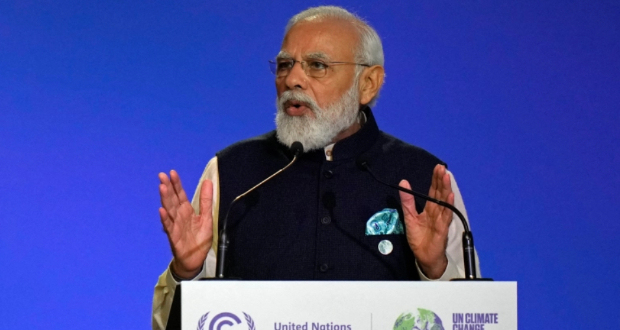
India’s economy will become carbon neutral by the year 2070, the country’s prime minster has announced at the COP26 climate crisis summit in Glasgow. The target date is two decades beyond what scientists say is needed to avert catastrophic climate impacts. India is the last of the world’s major carbon polluters to announce a net-zero target, with China saying it would reach that goal in 2060, and the United States and the European Union aiming for 2050.
COP26: What climate summit means for one woman in Bangladesh

China's carbon emissions are vast and growing, dwarfing those of other countries. Experts agree that without big reductions in China's emissions, the world cannot win the fight against climate change. In 2020, China's President Xi Jinping said his country would aim for its emissions to reach their highest point before 2030 and for carbon neutrality before 2060. His statement has now been confirmed as China's official position ahead of the COP26 global climate summit in Glasgow. But China has not said exactly how these goals will be achieved.
Why China's climate policy matters to us all

China's carbon emissions are vast and growing, dwarfing those of other countries. Experts agree that without big reductions in China's emissions, the world cannot win the fight against climate change. In 2020, China's President Xi Jinping said his country would aim for its emissions to reach their highest point before 2030 and for carbon neutrality before 2060. His statement has now been confirmed as China's official position ahead of the COP26 global climate summit in Glasgow. But China has not said exactly how these goals will be achieved.
Deliver on promises, developing world tells rich at climate talks

A crucial U.N. conference heard calls on its first day for the world's major economies to keep their promises of financial help to address the climate crisis, while big polluters India and Brazil made new commitments to cut emissions. World leaders, environmental experts and activists all pleaded for decisive action to halt the global warming which threatens the future of the planet at the start of the two-week COP26 summit in the Scottish city of Glasgow on Monday. The task facing negotiators was made even more daunting by the failure of the Group of 20 major industrial nations to agree ambitious new commitments at the weekend.