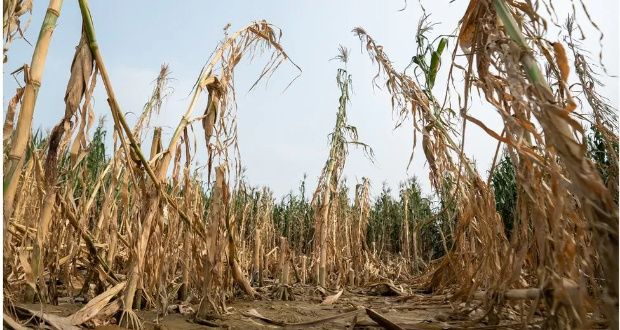
China’s summer of climate destruction
China's summer this year has seen both extreme heat and devastating floods.
And the flooding this time around has struck areas where such weather has been unheard of, with scientists - blaming climate change - warning that the worst is yet to come.
"I've never seen a flood here in my whole life," says 38-year-old Zhang Junhua, standing next to a vast patch of rice, now completely useless. "We just didn't expect it."
His family and friends are safe, he says, because they were given plenty of warning to get to higher ground, but everyone in his village now has some tough months ahead.
What's more, the devastation in north-east China's Heilongjiang Province has had a major impact on food supplies for the whole country.
This month, 40% of the area's famous Wuchang rice crop has been wiped out, visibly flattened by the volume and speed of the water. Places which should appear lush and green are today brown and dead.
"The fields where we planted our crops were all submerged. We can't plant again this year," says another farmer, Zhao Lijuan, as she smiles and tries to be philosophical about the impact on her community.
"The losses are incalculable. We have tens of thousands of acres of rice fields here," the 56-year-old says, adding: "When I saw the water come here, I cried. It laid waste to everything and I am scared the typhoons will be back."
At least 81 people have been killed in the recent floods, including some trying to rescue others.
But the economic pain has been much wider, in a country already struggling to recover following three years of strict coronavirus control measures.
India targets net-zero carbon emissions by 2070, says Modi
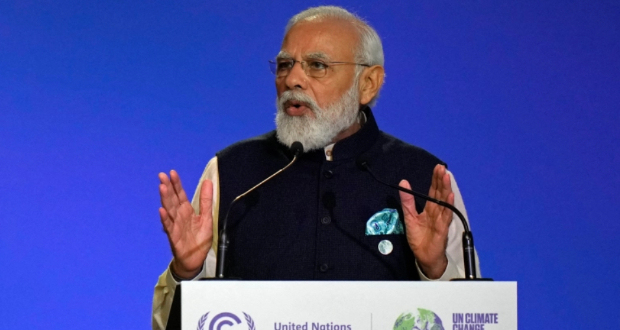
India’s economy will become carbon neutral by the year 2070, the country’s prime minster has announced at the COP26 climate crisis summit in Glasgow. The target date is two decades beyond what scientists say is needed to avert catastrophic climate impacts. India is the last of the world’s major carbon polluters to announce a net-zero target, with China saying it would reach that goal in 2060, and the United States and the European Union aiming for 2050.
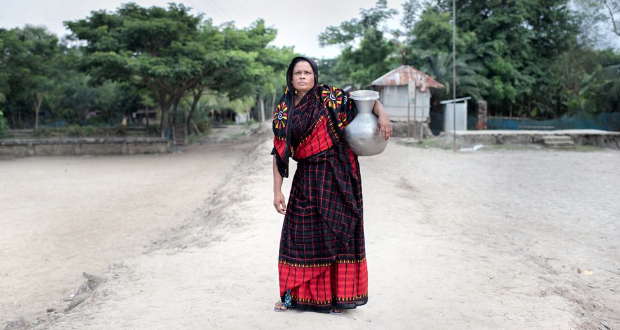
COP26: What climate summit means for one woman in Bangladesh
China's carbon emissions are vast and growing, dwarfing those of other countries. Experts agree that without big reductions in China's emissions, the world cannot win the fight against climate change. In 2020, China's President Xi Jinping said his country would aim for its emissions to reach their highest point before 2030 and for carbon neutrality before 2060. His statement has now been confirmed as China's official position ahead of the COP26 global climate summit in Glasgow. But China has not said exactly how these goals will be achieved.
Why China's climate policy matters to us all
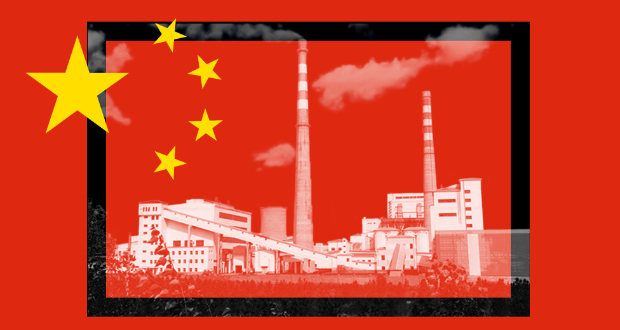
China's carbon emissions are vast and growing, dwarfing those of other countries. Experts agree that without big reductions in China's emissions, the world cannot win the fight against climate change. In 2020, China's President Xi Jinping said his country would aim for its emissions to reach their highest point before 2030 and for carbon neutrality before 2060. His statement has now been confirmed as China's official position ahead of the COP26 global climate summit in Glasgow. But China has not said exactly how these goals will be achieved.
Deliver on promises, developing world tells rich at climate talks

A crucial U.N. conference heard calls on its first day for the world's major economies to keep their promises of financial help to address the climate crisis, while big polluters India and Brazil made new commitments to cut emissions. World leaders, environmental experts and activists all pleaded for decisive action to halt the global warming which threatens the future of the planet at the start of the two-week COP26 summit in the Scottish city of Glasgow on Monday. The task facing negotiators was made even more daunting by the failure of the Group of 20 major industrial nations to agree ambitious new commitments at the weekend.