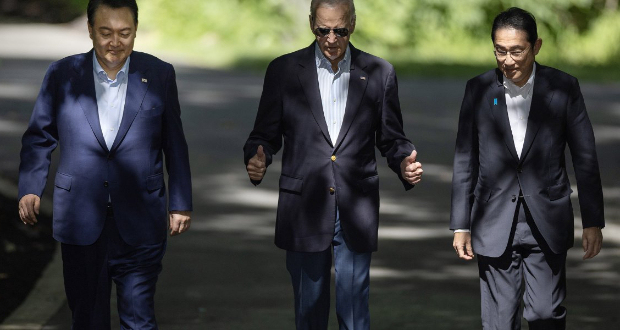
Trilateral meetings will also take place annually between foreign ministers, defense ministers, national security advisors and other cabinet-level principals. Cooperation between Washington, Seoul, and Tokyo will cover a wide range of issues including an annual, named set of trilateral military exercises, contingency planning, missile defense, economic security, supply chains, emerging technologies, development assistance, and countering disinformation. In this text compilation, CSIS Japan and Korea Chairs discuss the significance of the Camp David trilateral leaders’ summit in the context of Japan-ROK relations and U.S. Indo-Pacific Strategy.
Victor Cha:
Historically, dating back to the 1969 Nixon-Sato “Korea Clause,” the United States has wanted strong trilateral security cooperation with its two major allies: Japan and South Korea. The ability to do this, however, has always been stymied by the weakest link—Seoul-Tokyo bilateral relations—plagued by the inability to work past the difficult history of the colonial era. Camp David arguably accomplished this long-sought U.S. goal, but why now? Three factors deserve mention: First, the security environment compels allied cooperation. The Russian invasion of Ukraine, China’s assertiveness against Taiwan and unlawful territorial claims, as well as North Korea’s unending nuclear missile campaign has affected Seoul and Tokyo’s threat perceptions. Second, the efforts by South Korean president Yoon Suk Yeol to improve relations with Japan need to be recognized. When he decided to take on this domestically unpopular foreign policy objective, the bilateral relationship was dysfunctional: Korea was on Japan’s export control list, Japanese assets in Korea were under threat of being nationalized, Korea threatened to end intelligence sharing with Japan, and the two leaders were not talking.
It’s quite astounding how much progress has been made leading up to Camp David in this context: a resolution of forced labor compensation claims, two bilateral summits, and additional meetings on the sidelines of G7 and NATO. Finally, the Biden administration efforts at networking its bilateral alliances have also been critical—whether this is the Quad, AUKUS, or CHIPS alliance (among others). There is a lot to like about the opening of this new era of trilateral cooperation. There is also a lot that China and Russia will not like about it. The question going forward will be whether the three allies can produce deliverables for the ambitious agenda set out at Camp David.
Christopher B. Johnstone:
The history of trilateral cooperation is something of a pendulum, with periods of progress in ties that are swiftly reversed after changes in the security environment or in political leadership, particularly in Japan and South Korea. During the last era of strong cooperation, under the administrations of President Barack Obama, President Park Geun-hye, and Prime Minister Abe Shinzo, the three countries broke new ground in expanding information sharing and deepening defense cooperation. By 2016, the countries had a robust trilateral exercise program, with as many as six events in a calendar year in mission areas such as maritime interdiction, ballistic missile defense, and anti-submarine warfare. But all of this was quickly suspended after the elections of President Moon Jae-in in South Korea and President Donald Trump in the United States.