US, EU agree on Mideast-India rail and shipping corridor at G20
The US signed an agreement with India, Middle Eastern countries and the European Union aimed at connecting them via a network of railways and sea routes, a development that comes as China builds its influence across the energy-rich region.
The US has been quietly holding talks since January on the project with India, Saudi Arabia, the United Arab Emirates and Israel. The plan is to link Middle Eastern countries by rail and to India through shipping lanes from ports in the region, extending on to eastern Europe.
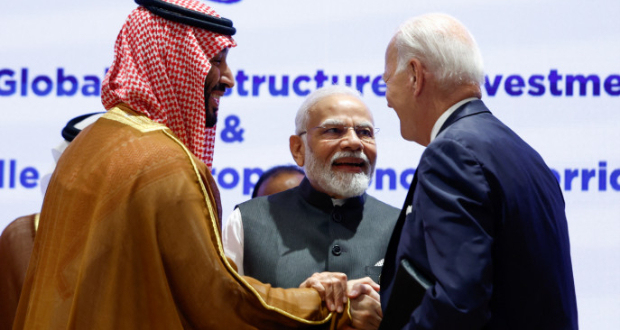
"This is a game-changing regional investment," US President Joe Biden said at an event announcing the plans. He thanked Saudi Crown Prince Mohammed bin Salman and India's Prime Minister Narendra Modi, who sat between them.
The Saudi prince also commended Biden, and they shook hands, appearing to want to emphasize improved relations after long-running frictions that flared again last year over oil.
The India-Middle East-Europe Economic Corridor will integrate railway lines and port connections from India to Europe, across UAE, Saudi Arabia, Jordan and Israel, leading to faster transit of goods.
The project will develop energy infrastructure and enable the production and transport of green hydrogen to all partner countries. It includes a new undersea cable connecting the region to improve telecommunications and data transfers.
Leaders will also develop a trans-African corridor to improve transport connections between the Katanga region of the Democratic Republic of Congo and the so-called "Copper Belt" in Zambia to Lobito port in Angola. The US and the EU are also backing this project, known as the Lobito Corridor.
The Middle East plan is more than just an infrastructure project, US Deputy National Security Adviser Jonathan Finer told reporters, saying the overall strategy was focused on "turning the temperature down" in a region that was historically a "net exporter of turbulence and insecurity."
The US declined to give a timeline for completion but Biden's senior adviser Amos Hochstein said countries would meet within the next 60 days to discuss that.
US officials dismissed the idea the project was about countering Chinese influence in emerging markets. But a French diplomat said there was competition with China's Belt and Road Initiative and that it was not necessarily a bad thing. Countries were also looking at how to involve Egypt in the plans.
The rail link will increase the speed of trade between India and Europe by 40%, European Commission President Ursula von der Leyen said.
India targets net-zero carbon emissions by 2070, says Modi
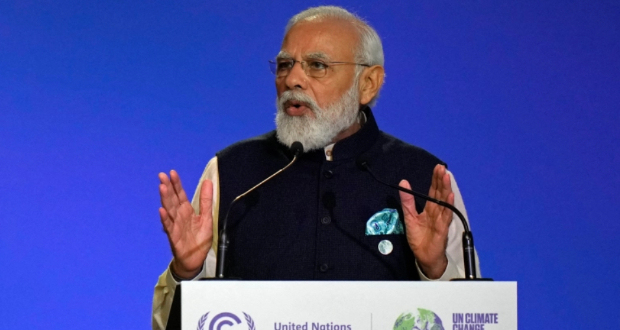
India’s economy will become carbon neutral by the year 2070, the country’s prime minster has announced at the COP26 climate crisis summit in Glasgow. The target date is two decades beyond what scientists say is needed to avert catastrophic climate impacts. India is the last of the world’s major carbon polluters to announce a net-zero target, with China saying it would reach that goal in 2060, and the United States and the European Union aiming for 2050.
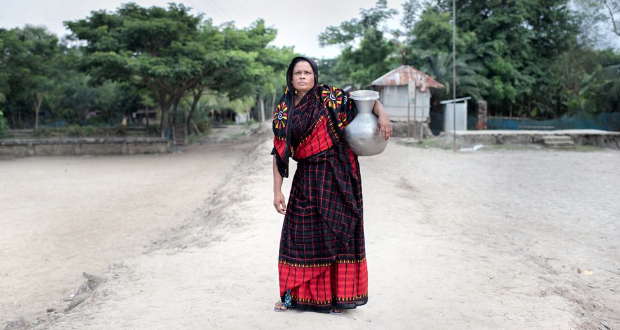
COP26: What climate summit means for one woman in Bangladesh
China's carbon emissions are vast and growing, dwarfing those of other countries. Experts agree that without big reductions in China's emissions, the world cannot win the fight against climate change. In 2020, China's President Xi Jinping said his country would aim for its emissions to reach their highest point before 2030 and for carbon neutrality before 2060. His statement has now been confirmed as China's official position ahead of the COP26 global climate summit in Glasgow. But China has not said exactly how these goals will be achieved.
Why China's climate policy matters to us all
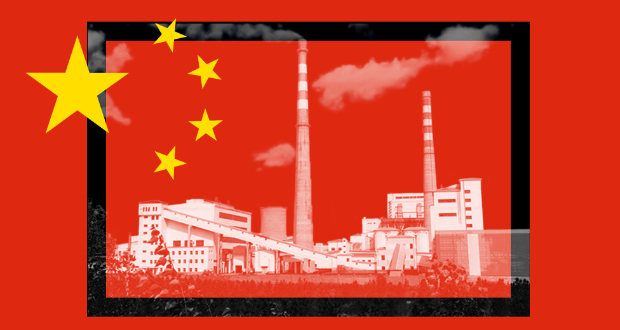
China's carbon emissions are vast and growing, dwarfing those of other countries. Experts agree that without big reductions in China's emissions, the world cannot win the fight against climate change. In 2020, China's President Xi Jinping said his country would aim for its emissions to reach their highest point before 2030 and for carbon neutrality before 2060. His statement has now been confirmed as China's official position ahead of the COP26 global climate summit in Glasgow. But China has not said exactly how these goals will be achieved.
Deliver on promises, developing world tells rich at climate talks

A crucial U.N. conference heard calls on its first day for the world's major economies to keep their promises of financial help to address the climate crisis, while big polluters India and Brazil made new commitments to cut emissions. World leaders, environmental experts and activists all pleaded for decisive action to halt the global warming which threatens the future of the planet at the start of the two-week COP26 summit in the Scottish city of Glasgow on Monday. The task facing negotiators was made even more daunting by the failure of the Group of 20 major industrial nations to agree ambitious new commitments at the weekend.