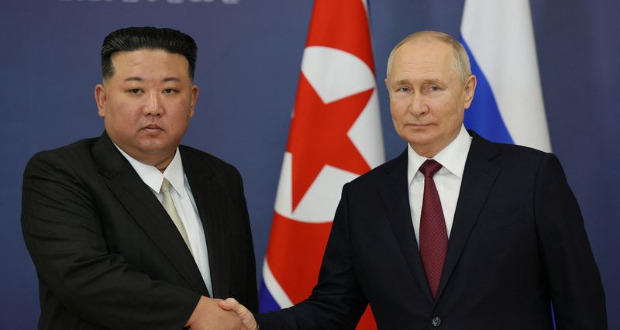
Putin and North Korea's Kim discuss military matters, Ukraine war and satellites

North Korean leader Kim Jong Un and Russian President Vladimir Putin met for a rare summit on Wednesday at which they discussed military matters, the war in Ukraine and possible Russian help for the secretive state's satellite programme.


Putin showed Kim around Russia's most advanced space rocket launch site in Russia's Far East and discussed the possibility of sending a North Korean cosmonaut into space. Kim, who arrived by train from North Korea, asked detailed questions about rockets as Putin showed him around the Vostochny Cosmodrome.

After the tour, Putin, 70, and Kim, 39, held talks for several hours with their ministers and then discussed world affairs and possible areas of cooperation one-on-one, followed by an opulent lunch of Russian "pelmeni" dumplings stuffed with Kamchatka crab and then sturgeon with mushrooms and potatoes.

Kim raised a toast with a glass of Russian wine to Putin's health, to the victory of "great Russia" and to Korean-Russian friendship, predicting victory for Moscow in its "sacred fight" with the West in the Ukraine war.

"The Russian army and people will certainly win a great victory in the sacred struggle for the punishment of a great evil that claims hegemony and feeds an expansionist illusion," Kim said, raising his glass.

U.S. and South Korean officials have expressed concern that Kim could provide weapons and ammunition to Russia, which has expended vast stocks in more than 18 months of war in Ukraine. Moscow and Pyongyang have denied such intentions.

Putin gave numerous hints that military cooperation was discussed but disclosed few details. Defence Minister Sergei Shoigu attended the talks. The Kremlin said sensitive discussions between neighbours were a private matter.

When asked by Russian media if Moscow would help Kim build satellites, Putin said: "That's why we came here."

Washington warned it would implement further sanctions over any weapons transfers by either country to the other, and said Putin was "begging" Kim for help after losing tens of thousands of troops in Ukraine.

"We have taken a number of actions already to sanction entities that brokered arms sales between North Korea and Russia, and we won't hesitate to impose additional sanctions if appropriate," U.S. State Department spokesman Matthew Miller said at a briefing.

He called it "troubling" that Russia would discuss cooperation with North Korea on programs that potentially would violate U.N. Security Council resolutions.

U.N. Secretary-General Antonio Guterres signalled Moscow had to tread carefully.

"Any form of cooperation of any country with North Korea must respect the sanctions regime that was imposed by the Security Council," Guterres told reporters, adding that it was "extremely relevant" in the case of Russia and North Korea.

Read Full Article:
Share This Article

Related Articles

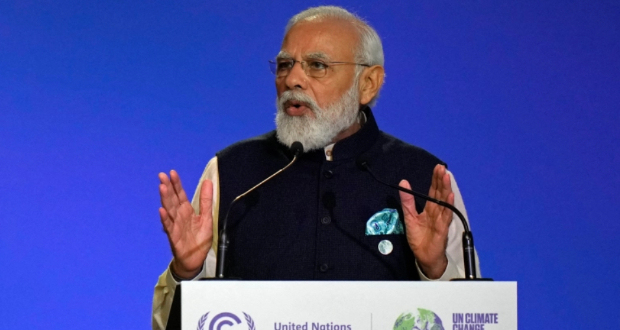
India targets net-zero carbon emissions by 2070, says Modi

India’s economy will become carbon neutral by the year 2070, the country’s prime minster has announced at the COP26 climate crisis summit in Glasgow. The target date is two decades beyond what scientists say is needed to avert catastrophic climate impacts. India is the last of the world’s major carbon polluters to announce a net-zero target, with China saying it would reach that goal in 2060, and the United States and the European Union aiming for 2050.

COP26: What climate summit means for one woman in Bangladesh

China's carbon emissions are vast and growing, dwarfing those of other countries. Experts agree that without big reductions in China's emissions, the world cannot win the fight against climate change. In 2020, China's President Xi Jinping said his country would aim for its emissions to reach their highest point before 2030 and for carbon neutrality before 2060. His statement has now been confirmed as China's official position ahead of the COP26 global climate summit in Glasgow. But China has not said exactly how these goals will be achieved.

Why China's climate policy matters to us all

China's carbon emissions are vast and growing, dwarfing those of other countries. Experts agree that without big reductions in China's emissions, the world cannot win the fight against climate change. In 2020, China's President Xi Jinping said his country would aim for its emissions to reach their highest point before 2030 and for carbon neutrality before 2060. His statement has now been confirmed as China's official position ahead of the COP26 global climate summit in Glasgow. But China has not said exactly how these goals will be achieved.

Deliver on promises, developing world tells rich at climate talks

A crucial U.N. conference heard calls on its first day for the world's major economies to keep their promises of financial help to address the climate crisis, while big polluters India and Brazil made new commitments to cut emissions. World leaders, environmental experts and activists all pleaded for decisive action to halt the global warming which threatens the future of the planet at the start of the two-week COP26 summit in the Scottish city of Glasgow on Monday. The task facing negotiators was made even more daunting by the failure of the Group of 20 major industrial nations to agree ambitious new commitments at the weekend.