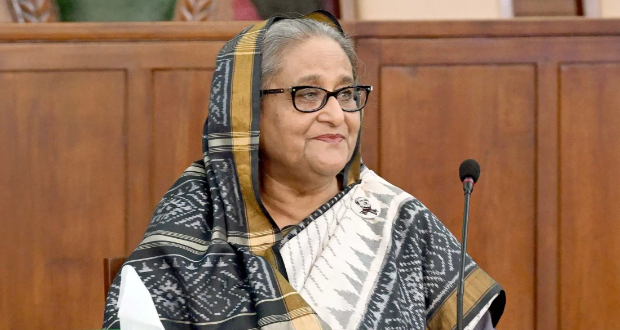
PM Hasina: Food security remains protected amid international crisis
Prime Minister Sheikh Hasina on Wednesday told the parliament that the country’s food security remains protected even amid the ongoing international crisis.
“Bangladesh has successfully faced Covid-19 pandemic. The food security remains protected in the country amid the current international crisis as well,” she said.
The premier made the remarks while replying to a question from Awami League lawmaker Md Shahiduzzaman Sarkar (Naogaon-2).
Earlier, Speaker Shirin Sharmin Chaudhry presented the question-answer session at the beginning of the day’s business.
The prime minister said Bangladesh has already attained food autarky. “The government has been working intensively to maintain our (food) self-sufficiency,” she said.
She said the crisis has been created in the global supply chain of different commodities including foods following the Covid-19 pandemic and the Russia-Ukraine war.
“In this situation, the government has regularly been taking various steps on national and international levels to ensure food security by facing this crisis,” said Hasina.
She said Bangladesh has successfully attained the food autarchy thanks to agricultural research, extension, continuous materials support and policy support in the agriculture sector.
“Bangladesh has now become a role model on the global stage in case of food security,” she said.
She said the country’s food grains production was 328.96 lakh metric tons in 2008-09 fiscal year, which went up to 477.68 lakh metric tons in 2022-23 fiscal year.
Efforts to continue for recognition of 1971 genocide
In reply to another question from Awami League lawmaker Anwer Hossain Khan (Laxmipur-1), the prime minister said many countries demanded the recognition of genocide committed in their respective countries as International Genocide Day.
Later, the United Nations General Assembly on September 11, 2015 adopted a resolution through discussion to observe December 9 as the International Day for the Prevention of Genocide.
“Since December 9 has been observed as the International Day for the Prevention of Genocide, the proposal to observe another International Day on the same issue would not be rational,” she said.
She, however, said the Ministry of Foreign Affairs, the Ministry of Liberation War Affairs and the Liberation War Museum and some members of the martyrs' families are making efforts to achieve international recognition of the genocide taken place in Bangladesh in 1971.
India targets net-zero carbon emissions by 2070, says Modi
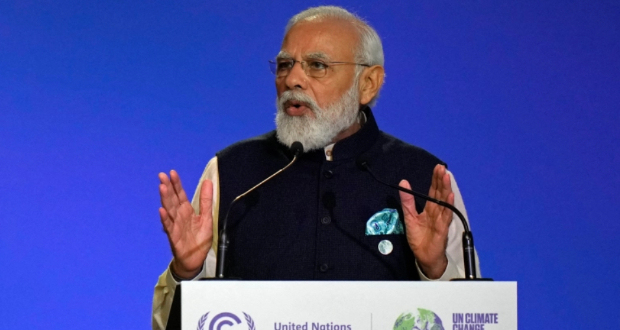
India’s economy will become carbon neutral by the year 2070, the country’s prime minster has announced at the COP26 climate crisis summit in Glasgow. The target date is two decades beyond what scientists say is needed to avert catastrophic climate impacts. India is the last of the world’s major carbon polluters to announce a net-zero target, with China saying it would reach that goal in 2060, and the United States and the European Union aiming for 2050.
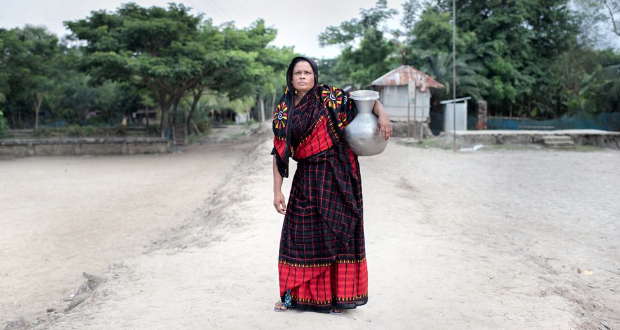
COP26: What climate summit means for one woman in Bangladesh
China's carbon emissions are vast and growing, dwarfing those of other countries. Experts agree that without big reductions in China's emissions, the world cannot win the fight against climate change. In 2020, China's President Xi Jinping said his country would aim for its emissions to reach their highest point before 2030 and for carbon neutrality before 2060. His statement has now been confirmed as China's official position ahead of the COP26 global climate summit in Glasgow. But China has not said exactly how these goals will be achieved.
Why China's climate policy matters to us all
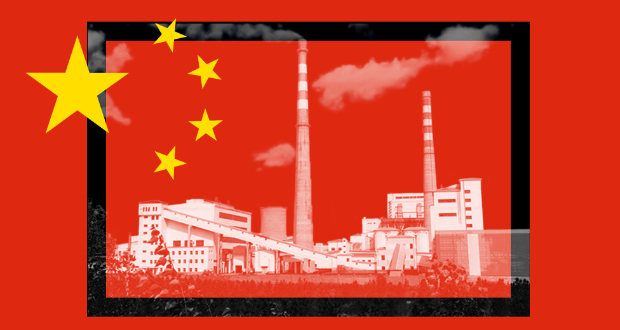
China's carbon emissions are vast and growing, dwarfing those of other countries. Experts agree that without big reductions in China's emissions, the world cannot win the fight against climate change. In 2020, China's President Xi Jinping said his country would aim for its emissions to reach their highest point before 2030 and for carbon neutrality before 2060. His statement has now been confirmed as China's official position ahead of the COP26 global climate summit in Glasgow. But China has not said exactly how these goals will be achieved.
Deliver on promises, developing world tells rich at climate talks

A crucial U.N. conference heard calls on its first day for the world's major economies to keep their promises of financial help to address the climate crisis, while big polluters India and Brazil made new commitments to cut emissions. World leaders, environmental experts and activists all pleaded for decisive action to halt the global warming which threatens the future of the planet at the start of the two-week COP26 summit in the Scottish city of Glasgow on Monday. The task facing negotiators was made even more daunting by the failure of the Group of 20 major industrial nations to agree ambitious new commitments at the weekend.