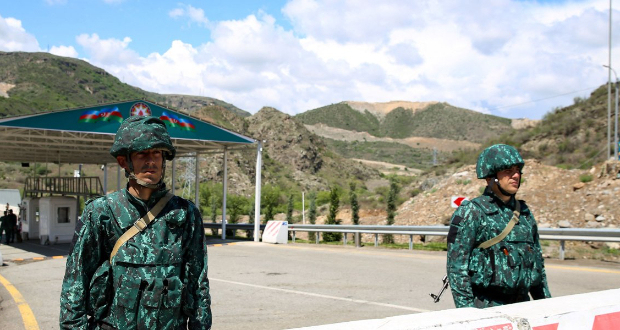
A Renewed Nagorno-Karabakh Conflict: Reading Between the Front Lines
On Tuesday, September 19, Azerbaijan launched an attack against ethnic Armenians in Nagorno-Karabakh. Nagorno-Karabakh, a contested mountainous region located in the South Caucasus, has been the epicenter of two large-scale conflicts and intermittent clashes between Armenia and Azerbaijan for well over three decades. Known as “Artsakh” among Armenians, the region is officially recognized as part of Azerbaijan, yet its population of 120,000 is predominantly ethnic Armenian and has a local government that has historically maintained close cultural, social, and political ties with Yerevan. During Soviet rule, Nagorno-Karabakh held the status of an autonomous region within the Republic of Azerbaijan. The weakening and ultimate collapse of the Soviet Union resulted in the first Karabakh war between 1988 and 1994, which killed around 30,000 people and displaced more than a million, ending with an Armenian victory.
The second war erupted in 2020, leading to more than 6,000 deaths, while Azerbaijani forces recaptured previously lost territories in and around Nagorno-Karabakh. A subsequent ceasefire agreement, brokered by Russia after a 44-day successful Azerbaijani offensive, provided for up to 1,960 Russian peacekeepers stationed in the region, including near the Lachin Corridor—the lone highway connecting the separatist region to Armenia that had previously been controlled by Armenian forces.
The deployment of Russian troops in a contested territory was initially perceived as an important step toward furthering the Kremlin’s entrenchment in the South Caucasus. But Russia’s full-scale invasion of Ukraine in 2022 has weakened its ability to effectively control and interfere in the decades-long conflict between the two neighboring states. This has created opportunities for other external actors—including Turkey, Israel, and Iran—to promote their own interests and agendas in the region. The renewed Azerbaijani offensive against Karabakh Armenians reflects these changing power dynamics, providing Western policymakers with an opportunity to step up as potential guarantors of longer-term peace and stability in the Caucasus—a title famously claimed by Russia.
Q1: Why did Azerbaijan initiate a new offensive against Karabakh Armenians?
A1: In the official statements issued by Azerbaijan’s defense ministry and presidential administration this Tuesday, Baku announced that it had begun an “anti-terrorist” operation in Nagorno-Karabakh aimed at neutralizing “illegal Armenian armed groups” engaged in sabotage and dissolving “the illegal regime” itself. The military operation was preceded by a nearly 10-month-long Azerbaijani blockade, prompted by what Baku has argued had been an illegal exploitation of the region’s natural resources by Karabakh Armenians. During the blockade, Azerbaijani troops closed the Lachin Corridor, through which Karabakh Armenians had been receiving food, medicine, and fuel supplies from Yerevan. As a result, the region’s 120,000 inhabitants experienced acute shortages of basic foodstuffs and medicines, as well as water and electricity. Residents claimed that Baku’s actions resembled “a slow-motion genocide,” using hunger as a weapon that would force them to leave the region once the road reopened.
On Wednesday—a day after Azerbaijan began its offensive, killing at least 200 people and injuring many more—Karabakh authorities surrendered and agreed to a Russia-brokered ceasefire, according to which the remaining units of Armenian forces would leave Nagorno-Karabakh. In a speech Wednesday evening, Azerbaijani president Ilham Aliyev lauded Baku’s ability to punish “the enemy properly” and regain full control over the region “with an iron fist.” By contrast, Armenian prime minister Nikol Pashinyan said that Yerevan was not involved in drafting the terms of the ceasefire and that he found the language confusing, considering that “Armenia doesn’t have an army in Nagorno-Karabakh.”
This Thursday, a first round of talks, focused on the future of the region and its 120,000 ethnic Armenian inhabitants, was held between Azerbaijani and Karabakh authorities. However, if the three-decades-long conflict has taught anything to its observers, it is that Russia-brokered peace in the region usually tends to be fragile and fleeting.
Q2: What is Russia’s role in the Nagorno-Karabakh conflict?
A2: Since the conflict began in the 1990s, both Azerbaijan and Armenia have rapidly militarized, positioning Nagorno-Karabakh as the site of a globally funded arms build-up. In 2020, Baku and Yerevan spent 5.4 and 4.9 percent of their respective gross domestic products on defense, compared to a global average of 2.4 percent.
India targets net-zero carbon emissions by 2070, says Modi
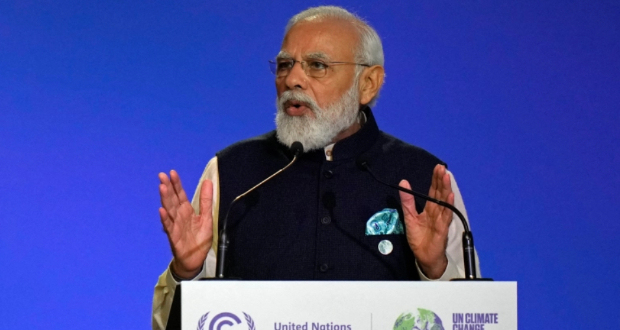
India’s economy will become carbon neutral by the year 2070, the country’s prime minster has announced at the COP26 climate crisis summit in Glasgow. The target date is two decades beyond what scientists say is needed to avert catastrophic climate impacts. India is the last of the world’s major carbon polluters to announce a net-zero target, with China saying it would reach that goal in 2060, and the United States and the European Union aiming for 2050.
COP26: What climate summit means for one woman in Bangladesh
China's carbon emissions are vast and growing, dwarfing those of other countries. Experts agree that without big reductions in China's emissions, the world cannot win the fight against climate change. In 2020, China's President Xi Jinping said his country would aim for its emissions to reach their highest point before 2030 and for carbon neutrality before 2060. His statement has now been confirmed as China's official position ahead of the COP26 global climate summit in Glasgow. But China has not said exactly how these goals will be achieved.
Why China's climate policy matters to us all
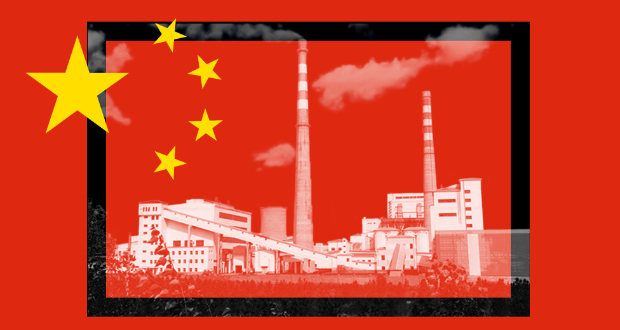
China's carbon emissions are vast and growing, dwarfing those of other countries. Experts agree that without big reductions in China's emissions, the world cannot win the fight against climate change. In 2020, China's President Xi Jinping said his country would aim for its emissions to reach their highest point before 2030 and for carbon neutrality before 2060. His statement has now been confirmed as China's official position ahead of the COP26 global climate summit in Glasgow. But China has not said exactly how these goals will be achieved.
Deliver on promises, developing world tells rich at climate talks

A crucial U.N. conference heard calls on its first day for the world's major economies to keep their promises of financial help to address the climate crisis, while big polluters India and Brazil made new commitments to cut emissions. World leaders, environmental experts and activists all pleaded for decisive action to halt the global warming which threatens the future of the planet at the start of the two-week COP26 summit in the Scottish city of Glasgow on Monday. The task facing negotiators was made even more daunting by the failure of the Group of 20 major industrial nations to agree ambitious new commitments at the weekend.