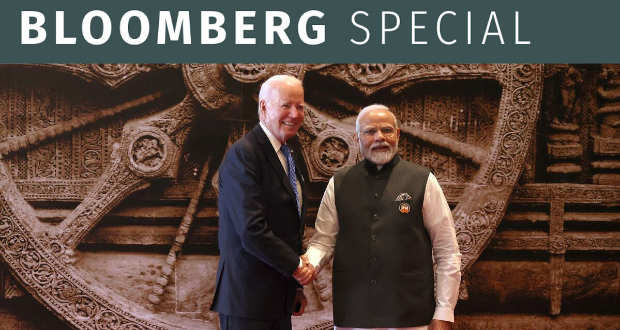
The US needs India to buffer China, and Modi knows it
The killing of a Sikh separatist in Canada in June, allegedly by agents of Prime Minister Narendra Modi's Indian government, has opened a rift between one of America's closest allies and one of its most vital geopolitical partners. It has also illustrated an unavoidable irony of President Joe Biden's foreign policy.
Biden aims to bolster a threatened global order by hastening India's rise. As India rises, however, it will act in ways that sometimes challenge the very order Washington must defend. And if Biden's team believes, as Asia policy czar Kurt Campbell has said, that the US and India have "the most important bilateral relationship on the planet," then Washington will probably tolerate a lot of bad behavior to keep that relationship intact.
The geopolitical case for US-India cooperation is unimpeachable. Way back in 1904, British polymath Sir Halford Mackinder explained why.
Thanks to the modernisation of both technology and tyranny, he wrote, there was a growing possibility that aggressive powers would dominate Eurasia and control its unmatched resources. So the era's liberal hegemon, Great Britain, must cultivate "bridge heads" on the edges of the supercontinent — Korea, France and India — so it could keep the world in balance by keeping Eurasia divided.
Today, large swaths of Eurasia are ruled by US enemies — a prickly, bellicose China; a vengeful, violent Russia; an expansionist Iran. India, an increasingly prosperous country of 1.4 billion people, may be the key to holding the balance — and particularly to denying China a free hand on land as it also expands at sea.
India is no less critical as a global manufacturing hub, a contributor to resilient technological supply chains, and a diplomatic leader of the developing world. This is why Biden has so prioritised strengthening US-India relations by hosting Modi for a state visit in Washington, helping make the recent G-20 meeting a showcase for Modi's leadership, and pursuing deeper cooperation across the board.
Yet Biden doesn't view India as a prospective military ally; he isn't counting on New Delhi to rush to America's assistance in a war with China over Taiwan. The idea is simply that America and India share a vital interest in keeping Beijing from dominating Asia and, perhaps, the world. So the US helps itself by helping India develop economically, mature militarily, and otherwise put its power athwart China's path to primacy.
India targets net-zero carbon emissions by 2070, says Modi
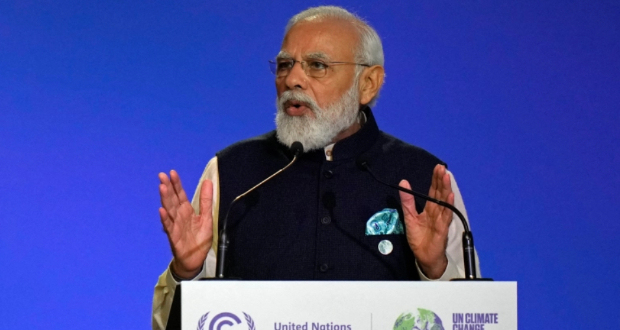
India’s economy will become carbon neutral by the year 2070, the country’s prime minster has announced at the COP26 climate crisis summit in Glasgow. The target date is two decades beyond what scientists say is needed to avert catastrophic climate impacts. India is the last of the world’s major carbon polluters to announce a net-zero target, with China saying it would reach that goal in 2060, and the United States and the European Union aiming for 2050.
COP26: What climate summit means for one woman in Bangladesh

China's carbon emissions are vast and growing, dwarfing those of other countries. Experts agree that without big reductions in China's emissions, the world cannot win the fight against climate change. In 2020, China's President Xi Jinping said his country would aim for its emissions to reach their highest point before 2030 and for carbon neutrality before 2060. His statement has now been confirmed as China's official position ahead of the COP26 global climate summit in Glasgow. But China has not said exactly how these goals will be achieved.
Why China's climate policy matters to us all
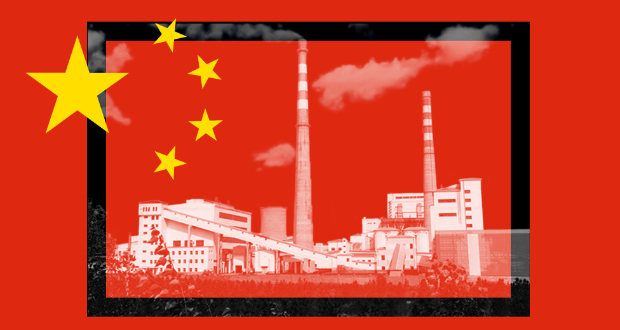
China's carbon emissions are vast and growing, dwarfing those of other countries. Experts agree that without big reductions in China's emissions, the world cannot win the fight against climate change. In 2020, China's President Xi Jinping said his country would aim for its emissions to reach their highest point before 2030 and for carbon neutrality before 2060. His statement has now been confirmed as China's official position ahead of the COP26 global climate summit in Glasgow. But China has not said exactly how these goals will be achieved.
Deliver on promises, developing world tells rich at climate talks

A crucial U.N. conference heard calls on its first day for the world's major economies to keep their promises of financial help to address the climate crisis, while big polluters India and Brazil made new commitments to cut emissions. World leaders, environmental experts and activists all pleaded for decisive action to halt the global warming which threatens the future of the planet at the start of the two-week COP26 summit in the Scottish city of Glasgow on Monday. The task facing negotiators was made even more daunting by the failure of the Group of 20 major industrial nations to agree ambitious new commitments at the weekend.