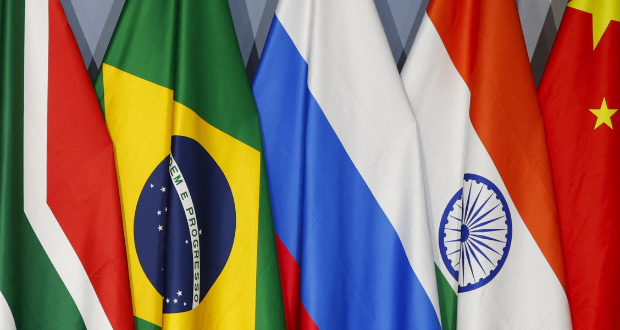
BRICS+ from Above: Why the Space Dimension of the Expanded Alliance Matters
Up until last August, there was little to link Argentina, Brazil, China, Egypt, Ethiopia, India, Iran, Russia, Saudi Arabia, South Africa, and the United Arab Emirates (UAE).
Since the decision to invite new members to the BRICS alliance, analysts have been wondering what this set of countries have in common. While at vastly different stages of economic development, the 11 will often adopt the moniker of members of the loosely defined “Global South.” However, where most see an amorphous grouping of countries—some formal U.S. allies and others traditional anti-Western autocracies—all have space programs and ambitions. This should not be overlooked in a context where the recent BRICS expansion can be seen as a largely symbolic move.
If all invited countries officially join BRICS, new collaborative space projects among its members are certainly possible. However, the more significant impact of the expansion may be in the space governance domain. Space governance refers to the complex set of laws, regulations, and frameworks that govern the use of space at both the international and national level. It is inherently a foreign policy issue because space is not owned by any one country and the physics of space requires international coordination. BRICS members have vowed to leverage their expected heftier weight in international institutions to better address the needs of the Global South. This counterweight strategy may spill over to the space-related discussions underway in those very forums, such as on international space security in the UN First Committee. While not topping the list of priorities dominated by economic issues, space governance is important—at stake are how to manage collective challenges like space debris and whether the next wave of space exploration will take an adversarial turn.
From Sputnik-1 to Chandrayaan-3
Space activities are deeply embedded into nearly every aspect of society—powering critical infrastructure like telecommunications, underpinning global financial transactions, fueling climate change research, and enabling asymmetric advantage in the military domain. Both as a power projection tool and a strategic investment to advance national goals, for countries around the world, space investments are no longer optional.
There is extensive debate around the complicated question of how to categorize national space programs without imposing technological biases. Regardless of what framework is used, the space programs of the BRICS+ countries (referring to existing and invited members) span the gamut—from Russia’s, responsible for the 1957 milestone that kicked off the Space Race, to Ethiopia’s, whose early efforts date to the same era but did not involve satellite operations until 2019. It is impossible to give justice to the breadth of these programs in a few words, but even cherry-picking some highlights shows the permanence of space efforts.
India targets net-zero carbon emissions by 2070, says Modi
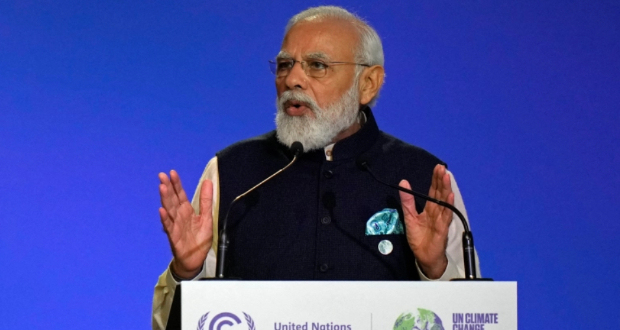
India’s economy will become carbon neutral by the year 2070, the country’s prime minster has announced at the COP26 climate crisis summit in Glasgow. The target date is two decades beyond what scientists say is needed to avert catastrophic climate impacts. India is the last of the world’s major carbon polluters to announce a net-zero target, with China saying it would reach that goal in 2060, and the United States and the European Union aiming for 2050.
COP26: What climate summit means for one woman in Bangladesh

China's carbon emissions are vast and growing, dwarfing those of other countries. Experts agree that without big reductions in China's emissions, the world cannot win the fight against climate change. In 2020, China's President Xi Jinping said his country would aim for its emissions to reach their highest point before 2030 and for carbon neutrality before 2060. His statement has now been confirmed as China's official position ahead of the COP26 global climate summit in Glasgow. But China has not said exactly how these goals will be achieved.
Why China's climate policy matters to us all
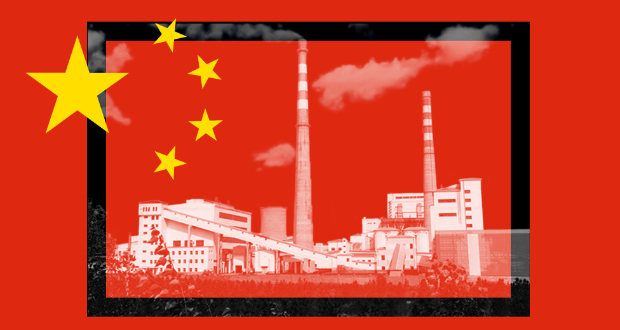
China's carbon emissions are vast and growing, dwarfing those of other countries. Experts agree that without big reductions in China's emissions, the world cannot win the fight against climate change. In 2020, China's President Xi Jinping said his country would aim for its emissions to reach their highest point before 2030 and for carbon neutrality before 2060. His statement has now been confirmed as China's official position ahead of the COP26 global climate summit in Glasgow. But China has not said exactly how these goals will be achieved.
Deliver on promises, developing world tells rich at climate talks

A crucial U.N. conference heard calls on its first day for the world's major economies to keep their promises of financial help to address the climate crisis, while big polluters India and Brazil made new commitments to cut emissions. World leaders, environmental experts and activists all pleaded for decisive action to halt the global warming which threatens the future of the planet at the start of the two-week COP26 summit in the Scottish city of Glasgow on Monday. The task facing negotiators was made even more daunting by the failure of the Group of 20 major industrial nations to agree ambitious new commitments at the weekend.