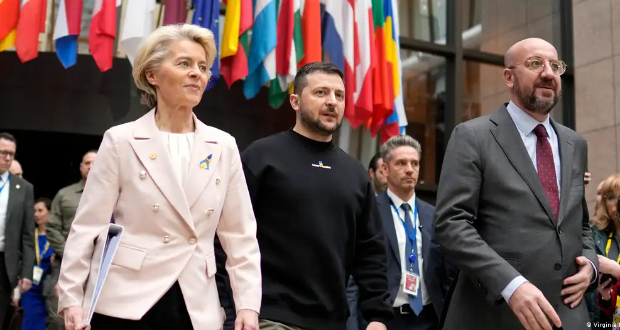
EU enlargement: Is the bloc ready for new members?
Since February 2022, a new consensus has settled in Brussels: The European Union needs to grow larger. EU members once considered enlargement skeptics now agree that it's time to start thinking seriously about welcoming hopefuls like Ukraine, Moldova and Western Balkan states into the club.
The shift was prompted by Russia's full-scale invasion of Ukraine. Before then, loose plans for expanding were Brussels' favorite proverbial can to kick down the road, passed from one administration to the next while aspirant members such as North Macedonia — an EU candidate since 2005 — jumped through a series of shapeshifting political and judicial hoops to qualify for access without ever exiting the waiting room.
These days, the mindset has changed. As one EU diplomat put it: "Enlargement is a reality now, and it wasn't a year and a half ago."
But Brussels has its own homework to do if the political consensus is to become a practical path. "Before you can have a realistic conversation with the countries coming in, we have to figure out what an enlarged EU would actually look like — and that's as far as we've gotten," the diplomat, who asked not to be named, told DW. "We know the questions but we don't really know the answers to them."
Tipping the balance of power: Making decisions at 30+
The conversation has, however, begun. Earlier this month, a group of researchers commissioned by France and Germany unveiled a paper full of ideas on the workings of and pathway toward a larger union. Thu Nguyen, a senior policy fellow at the Jacques Delors Centre in Berlin, was among them. She told DW that rethinking how the EU takes decisions could prove most politically challenging.
The official list of EU candidate countries is long: Ukraine, Moldova,Albania, Montenegro, Bosnia and Herzegovina, North Macedonia, Serbia and Turkey. Georgia and Kosovo are also considered "potential candidates."
India targets net-zero carbon emissions by 2070, says Modi
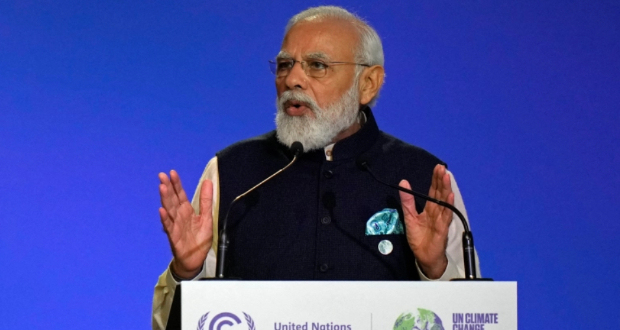
India’s economy will become carbon neutral by the year 2070, the country’s prime minster has announced at the COP26 climate crisis summit in Glasgow. The target date is two decades beyond what scientists say is needed to avert catastrophic climate impacts. India is the last of the world’s major carbon polluters to announce a net-zero target, with China saying it would reach that goal in 2060, and the United States and the European Union aiming for 2050.
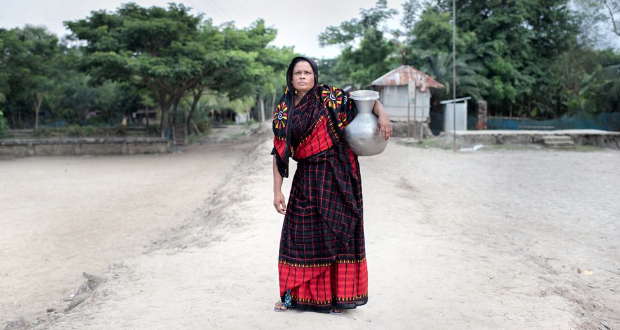
COP26: What climate summit means for one woman in Bangladesh
China's carbon emissions are vast and growing, dwarfing those of other countries. Experts agree that without big reductions in China's emissions, the world cannot win the fight against climate change. In 2020, China's President Xi Jinping said his country would aim for its emissions to reach their highest point before 2030 and for carbon neutrality before 2060. His statement has now been confirmed as China's official position ahead of the COP26 global climate summit in Glasgow. But China has not said exactly how these goals will be achieved.
Why China's climate policy matters to us all
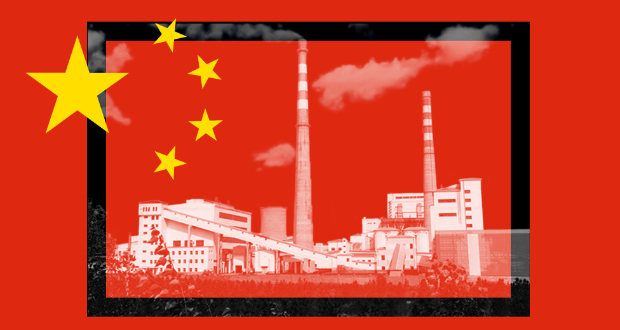
China's carbon emissions are vast and growing, dwarfing those of other countries. Experts agree that without big reductions in China's emissions, the world cannot win the fight against climate change. In 2020, China's President Xi Jinping said his country would aim for its emissions to reach their highest point before 2030 and for carbon neutrality before 2060. His statement has now been confirmed as China's official position ahead of the COP26 global climate summit in Glasgow. But China has not said exactly how these goals will be achieved.
Deliver on promises, developing world tells rich at climate talks

A crucial U.N. conference heard calls on its first day for the world's major economies to keep their promises of financial help to address the climate crisis, while big polluters India and Brazil made new commitments to cut emissions. World leaders, environmental experts and activists all pleaded for decisive action to halt the global warming which threatens the future of the planet at the start of the two-week COP26 summit in the Scottish city of Glasgow on Monday. The task facing negotiators was made even more daunting by the failure of the Group of 20 major industrial nations to agree ambitious new commitments at the weekend.