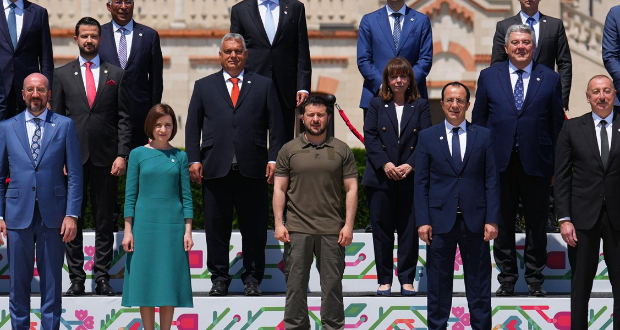
This alone gave value to this new platform, a brainchild of French president Emmanuel Macron in 2022, with the stated goal of building “strategic intimacy” among Europeans through informal and inclusive discussions on shared challenges for the continent. The initiative is the expression of a need to rethink foreign and security policy coordination in wider Europe, at a time of major geopolitical shifts.
The photo of the third summit in Granada, from the lavish Alhambra Palace, promises to be just as scenic. But the story behind the cover is less self-evident. The summit will be the hors d’oeuvre on the eve of an informal European Council, in which 27 EU leaders will reconvene to discuss enlargement, EU reform, and how to increase Europe’s resilience. As such, it is the first “routine summit” of the EPC, while the contours and objectives of the platform are not yet clear.
There is no shortage of crises for the EPC to tackle in wider Europe, as the fringes of the European Union and NATO have rarely witnessed such levels of tensions. In addition to Russia’s invasion of Ukraine, two flashpoints are in a crisis mode. The first is between Azerbaijan and Armenia, with the Azerbaijani final takeover of Nagorno-Karabakh. The second is in the Western Balkans, with renewed escalation between Serbia and Kosovo.
Yet, as the late cancellation of Azerbaijani president participation shows, this is a tricky situation for the EPC. Instead of showcasing European agency in dealing with crises unraveling on their continent, it might instead underline their difficulties to defuse tensions and sustain mediation efforts.
This in turn raises the question of what the EPC aims to achieve. As it enters its second year of existence, many observers still fail to capture the added value of the initiative, as it does not translate into concrete and tangible deliverables—the usual metric to measure success of diplomatic gatherings.
The EPC should be taken for what it is: an informal forum for leaders. This is a venue in which non-EU and non-NATO Europeans can come and talk as equals to their counterparts about shared challenges, not judged by the number of pre-accession chapters or reforms that they have fulfilled. A high-level gathering without talking points or final communiqué to negotiate, hence with less political posturing.
The main asset of the EPC remains its format. The relevant criteria to appraise its appeal is the turnout of leaders. And thus far, they keep coming. If not for the late volte-face of Ilham Aliyev and Recep Tayyip Erdoğan, almost all the 47 members will be represented at the highest level in Granada.
The EPC surely is also a preparation for the postwar Europe, that all Europeans—not only EU or NATO members—will have to rethink. Working on geopolitical convergence is indeed essential, as twenty-first century multilateralism, regionalism, and minilateralism are all under construction.
Having said that, for the EPC to go beyond summitry, at least some progress is needed when it comes to the key items on the agenda (security, energy, connectivity, resilience), as was the case for the lowering of roaming tariffs for Moldova for instance at the Chisinau summit.