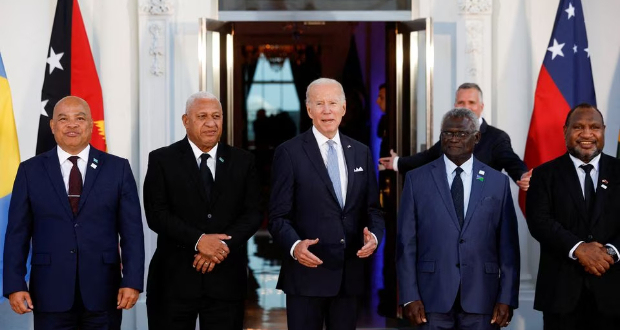
US budget fight could create opening for China in the Pacific
A 45-day stopgap measure passed by the U.S. Congress to avert a government shutdown has left potential funding shortfalls for strategic Pacific island states, which analysts and former officials say makes the U.S. allies economically vulnerable and possibly more receptive to Chinese approaches.
The Biden administration had hoped to see Congress endorse by Sept. 30 new 20-year funding programs for Micronesia, the Marshall Islands and Palau, which after decades of relative neglect now find themselves at the center of a U.S. battle for influence with China in the Northern Pacific.
The sprawling but sparsely populated nations have ties with the U.S. governed by so-called Compacts of Free Association (COFAs), under which Washington is responsible for their defense and provides economic assistance, while gaining exclusive military access to strategic swathes of ocean.
The funding programs for the Marshall Islands and Micronesia were due for renewal by Sept. 30, and by the end of fiscal 2024 for Palau, and Washington agreed this year on a new package of $7.1 billion over 20 years, subject to Congressional approval.
The stopgap "continuing resolution" (CR) that prevented a federal government shutdown does not include approval for this new program, however, and while it maintains federal services to the COFA states, it leaves holes in other parts of their budgets.
"While keeping the services going is an important assurance, the CR will make things quite difficult in the Marshalls (which has an election on November 20) and Palau (election next year)," said Cleo Paskal, an expert on the COFA states with the Foundation for Defense of Democracies think tank.
"Both are countries that recognize Taiwan and are key components of U.S. defense architecture in the Pacific," she said. "Watch for increased (Chinese) political warfare spin around the U.S. being an unreliable partner."
Paskal said Palau's funding under its existing COFA had dwindled as it approached its final year and it had been banking on funds from the new package to help cover budget deficits.
Paskal said Palau's economy had already taken bad hits from COVID-19 and Chinese economic interference aimed at pressuring it to switch diplomatic recognition from U.S.-backed Taiwan to Beijing.
There is no new money so far too for the Marshall Islands, which has yet to finalize new terms with Washington due to disagreements over how to address the legacy of massive U.S. nuclear testing there in the 1940s and 1950s.
Meanwhile, China is waiting in the wings with ready cash.
India targets net-zero carbon emissions by 2070, says Modi
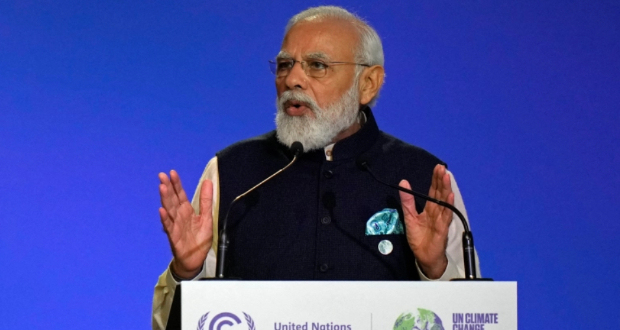
India’s economy will become carbon neutral by the year 2070, the country’s prime minster has announced at the COP26 climate crisis summit in Glasgow. The target date is two decades beyond what scientists say is needed to avert catastrophic climate impacts. India is the last of the world’s major carbon polluters to announce a net-zero target, with China saying it would reach that goal in 2060, and the United States and the European Union aiming for 2050.
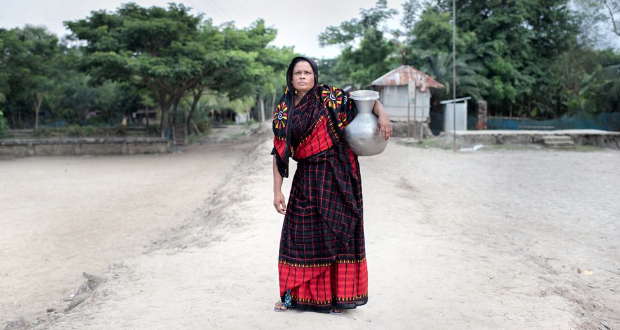
COP26: What climate summit means for one woman in Bangladesh
China's carbon emissions are vast and growing, dwarfing those of other countries. Experts agree that without big reductions in China's emissions, the world cannot win the fight against climate change. In 2020, China's President Xi Jinping said his country would aim for its emissions to reach their highest point before 2030 and for carbon neutrality before 2060. His statement has now been confirmed as China's official position ahead of the COP26 global climate summit in Glasgow. But China has not said exactly how these goals will be achieved.
Why China's climate policy matters to us all
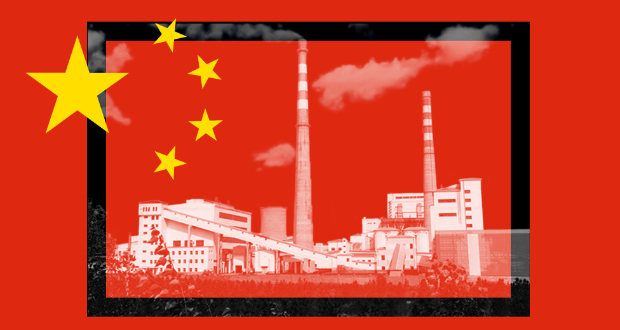
China's carbon emissions are vast and growing, dwarfing those of other countries. Experts agree that without big reductions in China's emissions, the world cannot win the fight against climate change. In 2020, China's President Xi Jinping said his country would aim for its emissions to reach their highest point before 2030 and for carbon neutrality before 2060. His statement has now been confirmed as China's official position ahead of the COP26 global climate summit in Glasgow. But China has not said exactly how these goals will be achieved.
Deliver on promises, developing world tells rich at climate talks

A crucial U.N. conference heard calls on its first day for the world's major economies to keep their promises of financial help to address the climate crisis, while big polluters India and Brazil made new commitments to cut emissions. World leaders, environmental experts and activists all pleaded for decisive action to halt the global warming which threatens the future of the planet at the start of the two-week COP26 summit in the Scottish city of Glasgow on Monday. The task facing negotiators was made even more daunting by the failure of the Group of 20 major industrial nations to agree ambitious new commitments at the weekend.