What happened in Israel? A breakdown of how Hamas attack unfolded

A surprise attack by Palestinian group Hamas on Israel – combining gunmen breaching security barriers and a barrage of rockets fired from Gaza – was launched at dawn during the Jewish holiday of Simchat Torah.

Saturday’s attack came 50 years and a day after Egyptian and Syrian forces launched an assault during the Jewish holiday of Yom Kippur in an effort to retrieve territory Israel had taken during a brief conflict in 1967.

Here’s how the brazen assault unfolded:

03:30 GMT – Covering rocket fire

  • At about 6:30am (03:30 GMT) Hamas fired a huge barrage of rockets into southern Israel with sirens heard as far away as Tel Aviv and Beersheba.
  • Hamas said it launched 5,000 rockets in an initial barrage. Israel’s military said 2,500 rockets were fired.
  • Smoke billowed over residential Israeli areas and people sheltered behind buildings as sirens sounded. At least one woman was reported killed by the rockets.
  • “We announce the start of Operation Al-Aqsa Flood and we announce that the first strike, which targeted enemy positions, airports, and military fortifications, exceeded 5,000 missiles and shells,” Mohammed Deif, head of the al-Qassam Brigades, the military wing of Hamas, said.
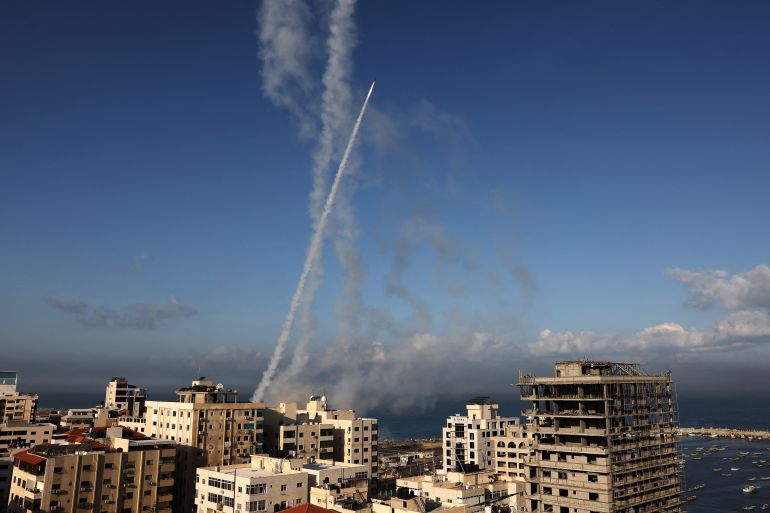
Rockets are fired from Gaza City towards Israel

04:40 GMT – Dawn infiltration

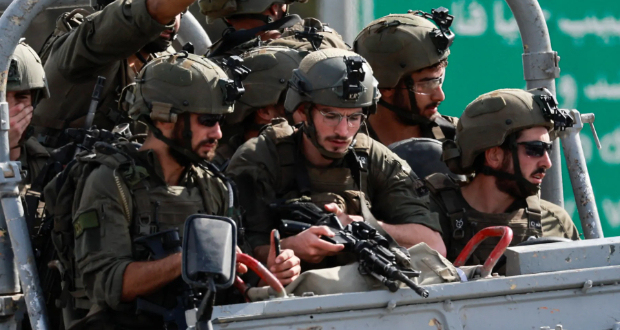
  • The rocket attack served as cover for an unprecedented multi-pronged infiltration of fighters with the Israeli military saying at 7:40am (04:40 GMT) that Palestinian gunmen had crossed into Israel.
  • Most fighters entered through breaches in security barriers separating Gaza and Israel. But at least one Hamas soldier was filmed flying over in a powered parachute. A motorboat carrying fighters was seen heading to Zikim, an Israeli coastal town with a military base.
  • One video showed at least six motorcycles with fighters crossing through a hole in a metal barrier. A photograph released by Hamas showed a bulldozer tearing down a section of fence.
04:40 GMT – Dawn infiltration

  • The rocket attack served as cover for an unprecedented multi-pronged infiltration of fighters with the Israeli military saying at 7:40am (04:40 GMT) that Palestinian gunmen had crossed into Israel.
  • Most fighters entered through breaches in security barriers separating Gaza and Israel. But at least one Hamas soldier was filmed flying over in a powered parachute. A motorboat carrying fighters was seen heading to Zikim, an Israeli coastal town with a military base.
  • One video showed at least six motorcycles with fighters crossing through a hole in a metal barrier. A photograph released by Hamas showed a bulldozer tearing down a section of fence.
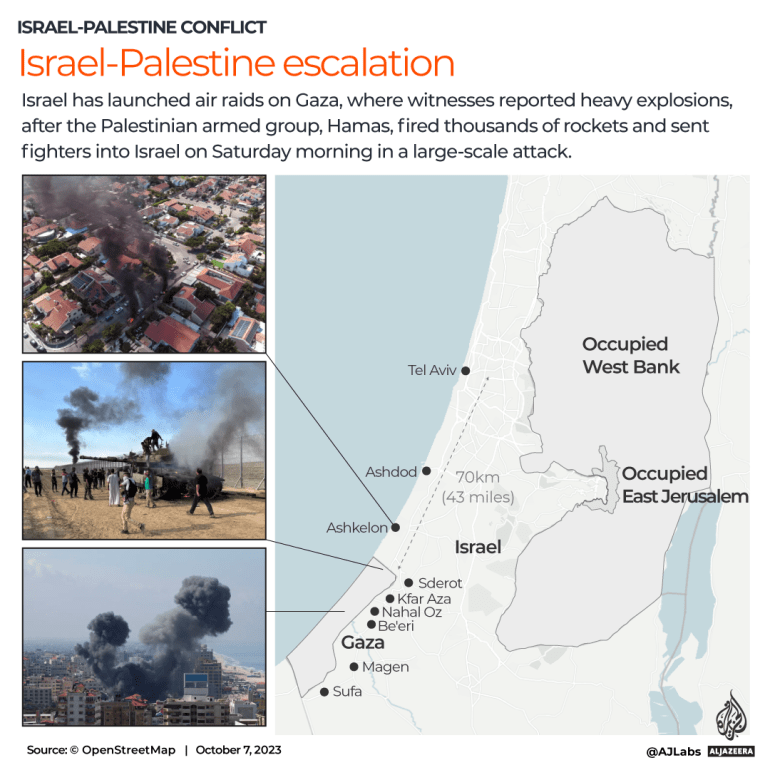
INTERACTIVE---Gaza-escalation-map-1696682587

Border town raids

  • Fighters raided the Israeli town of Sderot, another community Be’eri, and the town of Ofakim, 30km (20 miles) east of Gaza, according to Israeli media.
  • Residents of southern Israel fortified their homes to function as bomb shelters and were using them as panic rooms. Israel’s military ordered residents to shelter inside, saying on the radio, “We will reach you.”
  • By late evening, Israeli troops were still working to clear communities overrun by Hamas fighters.

Read Full Article:

Share This Article

Related Articles

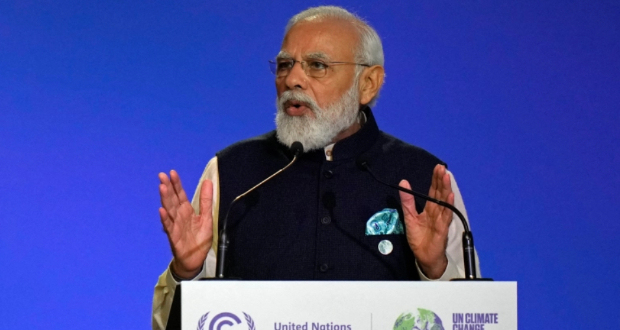
India targets net-zero carbon emissions by 2070, says Modi

India’s economy will become carbon neutral by the year 2070, the country’s prime minster has announced at the COP26 climate crisis summit in Glasgow. The target date is two decades beyond what scientists say is needed to avert catastrophic climate impacts. India is the last of the world’s major carbon polluters to announce a net-zero target, with China saying it would reach that goal in 2060, and the United States and the European Union aiming for 2050.

COP26: What climate summit means for one woman in Bangladesh

China's carbon emissions are vast and growing, dwarfing those of other countries. Experts agree that without big reductions in China's emissions, the world cannot win the fight against climate change. In 2020, China's President Xi Jinping said his country would aim for its emissions to reach their highest point before 2030 and for carbon neutrality before 2060. His statement has now been confirmed as China's official position ahead of the COP26 global climate summit in Glasgow. But China has not said exactly how these goals will be achieved.

Why China's climate policy matters to us all

China's carbon emissions are vast and growing, dwarfing those of other countries. Experts agree that without big reductions in China's emissions, the world cannot win the fight against climate change. In 2020, China's President Xi Jinping said his country would aim for its emissions to reach their highest point before 2030 and for carbon neutrality before 2060. His statement has now been confirmed as China's official position ahead of the COP26 global climate summit in Glasgow. But China has not said exactly how these goals will be achieved.

Deliver on promises, developing world tells rich at climate talks

A crucial U.N. conference heard calls on its first day for the world's major economies to keep their promises of financial help to address the climate crisis, while big polluters India and Brazil made new commitments to cut emissions. World leaders, environmental experts and activists all pleaded for decisive action to halt the global warming which threatens the future of the planet at the start of the two-week COP26 summit in the Scottish city of Glasgow on Monday. The task facing negotiators was made even more daunting by the failure of the Group of 20 major industrial nations to agree ambitious new commitments at the weekend.