South Africa's growing xenophobia problem
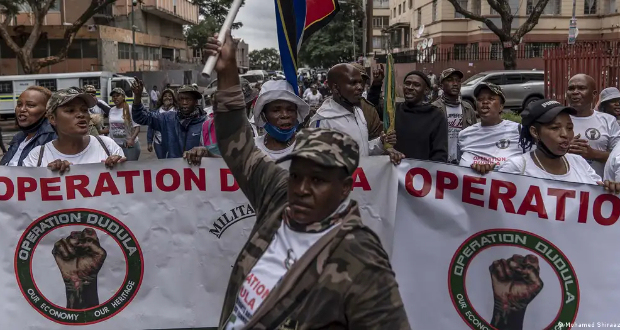
The self-appointed civilian army patrolling the streets in South Africa's Soweto Township had one aim only: To drive out foreigners. A mob made up of people supporting the anti-immigrant group Operation Dudula stormed into so-called Spaza shops run by foreigners in the village of Diepkloof, where they harassed owners — inspecting the sell-by dates on their products and threatening to close the shops.
Victress Mathuthu, who is from Zimbabwe, was one of those targeted by xenophobic Black South Africans. "If the members of Operation Dudula are dissatisfied with foreign nationals being granted licenses to run small businesses, they should address the government or the relevant ministry.
Attacks on foreign-owned shops
Operation Dudula supporters have claimed that relevant ministries are not doing enough to stop foreigners from owning businesses, using this as justification for taking the law into their own hands.
"They are not allowed to own a Spaza shop," claims Thabo Ngayo during one such vigilante operation. Dudula's national coordinator, Ngayo said the businesses are reserved solely for South Africans, before telling the shop owner, "That means this Spaza shop must belong to a South African. You have a few days to vacate the premises." The same goes for foreign owners who have registered their businesses the Dudula leader said.
Mzwanele Manyi, a representative of the Economic Freedom Fighters party, agrees. He, too, is calling for the closure of all foreign-owned Spaza shops in South Africa. "We simply cannot tolerate such a situation," Manyi told DW.
Xenophobia has deep roots in South Africa
Xenophobia is nothing new in South Africa. In April 2022, a Zimbabwean in Diepsloot, north of Johannesburg, was stoned and set on fire. In 2008, Black South Africans torched huts belonging to foreigners in their townships, killing 62 people. The outrage sparked by the wave of hate killings was widespread, yet investigations started by initiatives at the time went nowhere.
The platform Xenowatch, which was developed by the African Center for Migration and Society (ACMS) at the University of Witwatersrand, collects data on crimes against foreigners. They recorded 1,038 attacks on migrants, 661 deaths and 5,131 shops looted since 1994. Xenowatch says this is almost certainly an underestimation, as not every case is reported.
South Africa's right-wing scene is growing
The group Operation Dudula first appeared on social media in 2020. Dudula is a Zulu word meaning "push back." The group is now registered as a political party and will take part in the country's 2024 general election.
But Dudula candidates won't be the only ones chanting xenophobic slogans on the campaign trail. The Economic Freedom Fighters, currently South Africa's third-strongest party, also uses them. Though the party takes a radical leftist approach to the economy, it is also openly xenophobic.
Other smaller parties, such as the Patriotic Alliance and ActionSA, have also inciting against foreigners. The latter was able to score points with xenophobic sloganeering during last year's municipal elections.
India targets net-zero carbon emissions by 2070, says Modi
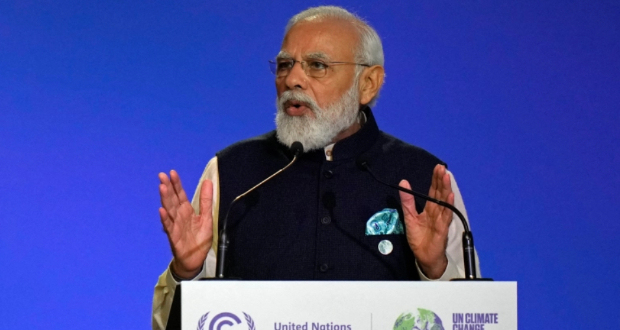
India’s economy will become carbon neutral by the year 2070, the country’s prime minster has announced at the COP26 climate crisis summit in Glasgow. The target date is two decades beyond what scientists say is needed to avert catastrophic climate impacts. India is the last of the world’s major carbon polluters to announce a net-zero target, with China saying it would reach that goal in 2060, and the United States and the European Union aiming for 2050.
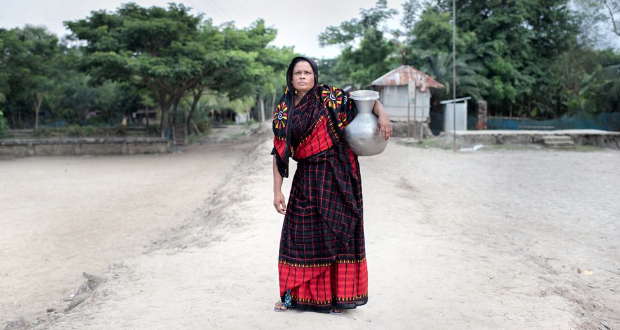
COP26: What climate summit means for one woman in Bangladesh
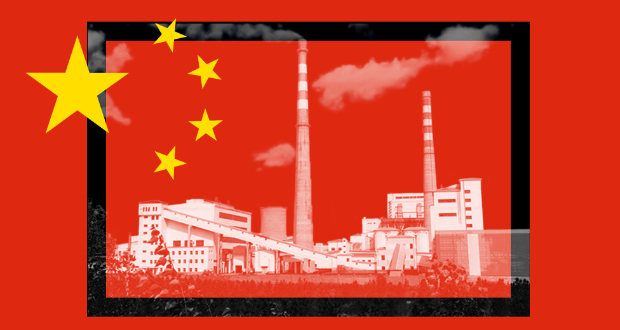
China's carbon emissions are vast and growing, dwarfing those of other countries. Experts agree that without big reductions in China's emissions, the world cannot win the fight against climate change. In 2020, China's President Xi Jinping said his country would aim for its emissions to reach their highest point before 2030 and for carbon neutrality before 2060. His statement has now been confirmed as China's official position ahead of the COP26 global climate summit in Glasgow. But China has not said exactly how these goals will be achieved.
Why China's climate policy matters to us all
China's carbon emissions are vast and growing, dwarfing those of other countries. Experts agree that without big reductions in China's emissions, the world cannot win the fight against climate change. In 2020, China's President Xi Jinping said his country would aim for its emissions to reach their highest point before 2030 and for carbon neutrality before 2060. His statement has now been confirmed as China's official position ahead of the COP26 global climate summit in Glasgow. But China has not said exactly how these goals will be achieved.
Deliver on promises, developing world tells rich at climate talks

A crucial U.N. conference heard calls on its first day for the world's major economies to keep their promises of financial help to address the climate crisis, while big polluters India and Brazil made new commitments to cut emissions. World leaders, environmental experts and activists all pleaded for decisive action to halt the global warming which threatens the future of the planet at the start of the two-week COP26 summit in the Scottish city of Glasgow on Monday. The task facing negotiators was made even more daunting by the failure of the Group of 20 major industrial nations to agree ambitious new commitments at the weekend.