The space launch vehicle traveled southward toward the Philippines. This is North Korea’s third satellite launch this year after its two failed attempts in May and August.
Q1: Why did North Korea launch a military reconnaissance satellite at this time?
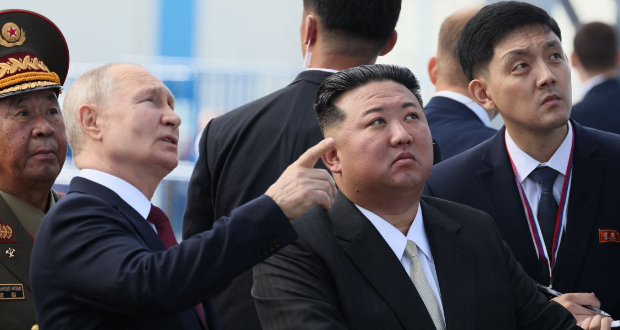
A1: There are three explanations. First, this is the direct result of assistance from Russia. Kim Jong-un’s visit to the Vostochny Cosmodrome spaceport in September (his first stop on the Russia trip) evinced a clear priority in what he wanted from Putin in terms of military satellite technology and a space program. The failure of North Korea’s two previous attempts signifies a strong causal connection between Russian support and the pre-summit and post-summit launch results.
Second, the military reconnaissance satellite has been a stated goal of North Korea’s weapons programs, as announced by Kim Jong-un in January 2021, to improve the country’s intelligence and reconnaissance capability. In April 2023, Kim also referred to the acquisition of a military reconnaissance capability as a “primary task” to enhance the country’s army.
Lastly, North Korea may have wanted to preempt South Korea’s scheduled launch of its first domestically built reconnaissance satellite at the end of this month. This is not the first time North Korea has shown its competition with South Korea. North Korea’s first yet failed satellite launch came six days after South Korea successfully launched its homegrown Nuri rocket on May 25 this year.
Q2: What are the implications of North Korea’s satellite launch?
A2: North Korea is profiting handsomely from Russia’s war in Ukraine. By giving weapons and ammunition to Russia, North Korea is receiving not just food and fuel assistance but also military satellite technology and possibly other advanced technology, such as nuclear-powered submarines and ballistic missiles. Recent CSIS Beyond Parallel satellite imagery reveals an unprecedented number of arms transfers and other trade activities taking place at the Najin port and the Khansan-Tsumangang border between the two countries that started around the time of the Kim-Putin summit.
The launch will reveal the inability of the United Nations Security Council to enforce the 10 United Nations Security Council Resolutions (UNSCRs) now levied against North Korea. China and Russia will not support any punitive actions by the UNSC to punish North Korea. For Russia, even though the country has supported these UNSCRs before, its own action to assist North Korea in violating these resolutions would be a major blow to the international nonproliferation regime and rules-based international order.
A fully functional military satellite capability will give North Korea real-time information about U.S. and South Korean military activities on the peninsula. This could also afford North Korea progress in fielding a survivable nuclear deterrent. At the same time, this could also show North Korea that its professed claim of an imminent attack by the United States and South Korea is not a reality, and this could help stabilize the peninsula.
Q3: North Korea claims a sovereign right to civilian satellite launch vehicles (SLVs). Is this right?