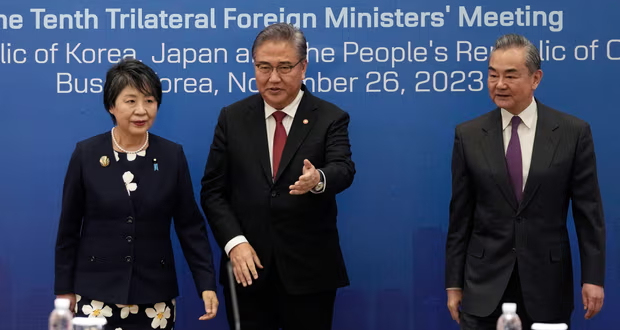
China, Japan and South Korea, amid regional rivalries, line up leaders’ summit
The leaders of China, Japan and South Korea will meet, possibly next year, in the latest attempt to ease regional tensions heightened by North Korea’s weapons programme and a more visible US military presence.
During a meeting in the South Korean port city of Busan on Sunday, the three Asian countries’ foreign ministers agreed to step up cooperation in key areas, including security, and to lay the groundwork for what would be the first leaders’ summit in four years.
The weekend’s trilateral meeting – the first between the neighbours’ foreign ministers since 2019 – came soon after the Chinese and US presidents, Xi Jinping and Joe Biden, met on the sidelines of the Apec summit in California.
The Asia summit – preparations for which began in September during talks between the countries’ deputy foreign ministers – is in part designed to address Chinese concerns over closer security ties between Japan, South Korea and the US.
While not expected to take place this year, the meeting between Xi of China, the South Korean president, Yoon Suk Yeol, and the Japanese prime minister, Fumio Kishida, is expected “in the near future”, according to South Korea’s national security adviser, Cho Tae-yong.
“The three ministers reaffirmed … to hold the summit, the pinnacle of the trilateral cooperation system, at the earliest, mutually convenient time,” South Korea’s foreign minister, Park Jin, told reporters. “We agreed to expedite the necessary preparations.”
In comments clearly aimed at security cooperation between Seoul, Tokyo and Washington, the Chinese foreign minister, Wang Yi, urged the three countries to “oppose ideological demarcation and resist putting regional cooperation into camps”.
North Korea was also on the agenda during Sunday’s 100-minute meeting, a few days after Pyongyang successfully put a spy satellite incorporating banned ballistic missile technology into orbit, in its latest show of defiance against UN-led sanctions targeting its nuclear and missile programmes.
India targets net-zero carbon emissions by 2070, says Modi
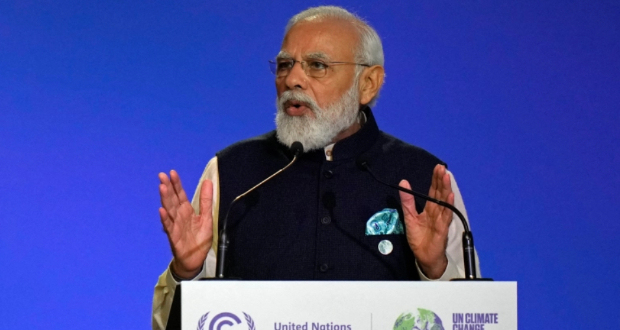
India’s economy will become carbon neutral by the year 2070, the country’s prime minster has announced at the COP26 climate crisis summit in Glasgow. The target date is two decades beyond what scientists say is needed to avert catastrophic climate impacts. India is the last of the world’s major carbon polluters to announce a net-zero target, with China saying it would reach that goal in 2060, and the United States and the European Union aiming for 2050.
COP26: What climate summit means for one woman in Bangladesh

China's carbon emissions are vast and growing, dwarfing those of other countries. Experts agree that without big reductions in China's emissions, the world cannot win the fight against climate change. In 2020, China's President Xi Jinping said his country would aim for its emissions to reach their highest point before 2030 and for carbon neutrality before 2060. His statement has now been confirmed as China's official position ahead of the COP26 global climate summit in Glasgow. But China has not said exactly how these goals will be achieved.
Why China's climate policy matters to us all
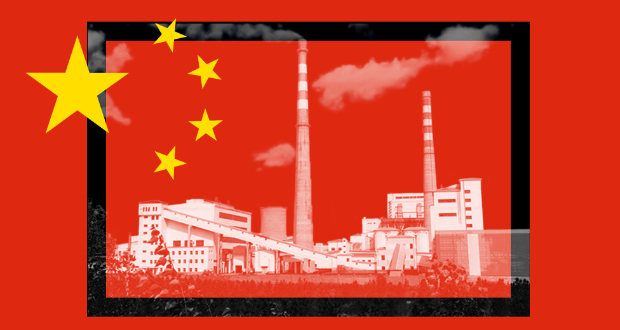
China's carbon emissions are vast and growing, dwarfing those of other countries. Experts agree that without big reductions in China's emissions, the world cannot win the fight against climate change. In 2020, China's President Xi Jinping said his country would aim for its emissions to reach their highest point before 2030 and for carbon neutrality before 2060. His statement has now been confirmed as China's official position ahead of the COP26 global climate summit in Glasgow. But China has not said exactly how these goals will be achieved.
Deliver on promises, developing world tells rich at climate talks

A crucial U.N. conference heard calls on its first day for the world's major economies to keep their promises of financial help to address the climate crisis, while big polluters India and Brazil made new commitments to cut emissions. World leaders, environmental experts and activists all pleaded for decisive action to halt the global warming which threatens the future of the planet at the start of the two-week COP26 summit in the Scottish city of Glasgow on Monday. The task facing negotiators was made even more daunting by the failure of the Group of 20 major industrial nations to agree ambitious new commitments at the weekend.