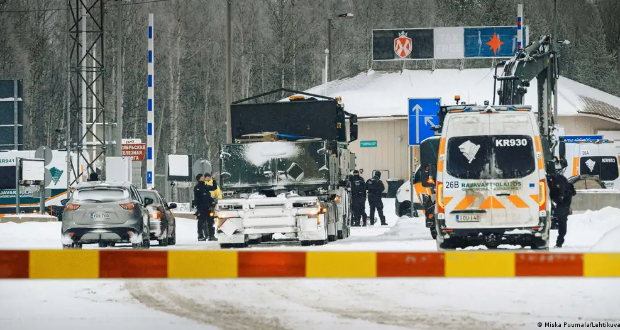
Finland seals border with Russia amid migrant crisis
Prime Minister Petteri Orpo on Tuesday said Finland will close its final remaining border crossing with Russia, accusing the Kremlin of using migrants as part of "hybrid warfare" aimed at destabilizing the Nordic country following its entry into NATO.
This month, Finnish authorities say about 900 crossed from Russia, an unusual increase, but as part of a rising trend since August.
"The government has decided to close all the crossing points on the entire eastern border," Prime Minister Petteri Orpo told reporters, adding it was an "exceptional" situation that the government blames on Moscow.
'Russia caused this situation,' says PM
"Finland has a profound reason to suspect that the entry (of migrants) is organized by a foreign state. This deals with Russia's influencing operations and we won't accept it," Orpo said.
"We don't accept any attempt to undermine our national security. Russia has caused this situation and it can also stop it."
Finland had already closed seven of its eight checkpoints on the 1,340-kilometer (830-mile) long stretch it shares with Russia.
Helsinki has accused Moscow of encouraging migrants from the Middle East and Africa toward the border through thick forests in the south to the rugged Arctic landscape in the north.
Russia denies Finnish allegations amid migrant spike
Since August, around 1,000 migrants have entered Finland, without visas or valid documentation. People from countries including Afghanistan, Eritrea, Ethiopia, Iraq, Pakistan, Somalia, Syria and Yemen, have come to the border, most of them seeking asylum.
Finnish Foreign Minister Elina Valtonen said that Russia "is instrumentalizing migrants" as part of its "hybrid warfare."
Before joining NATO this year, a decision prompted by Moscow's invasion of Ukraine, Finnish officials warned that Russia could seek ways to destabilize the country in retaliation, including cyber attacks and ushering migrants to its borders.
India targets net-zero carbon emissions by 2070, says Modi
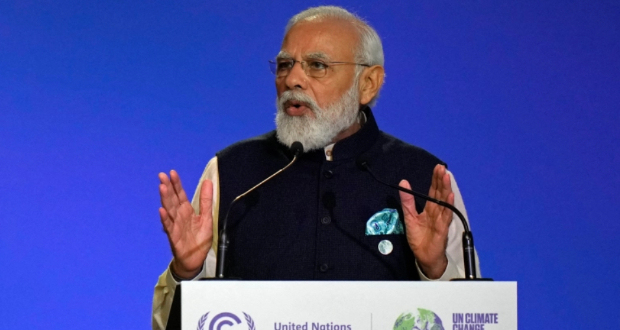
India’s economy will become carbon neutral by the year 2070, the country’s prime minster has announced at the COP26 climate crisis summit in Glasgow. The target date is two decades beyond what scientists say is needed to avert catastrophic climate impacts. India is the last of the world’s major carbon polluters to announce a net-zero target, with China saying it would reach that goal in 2060, and the United States and the European Union aiming for 2050.
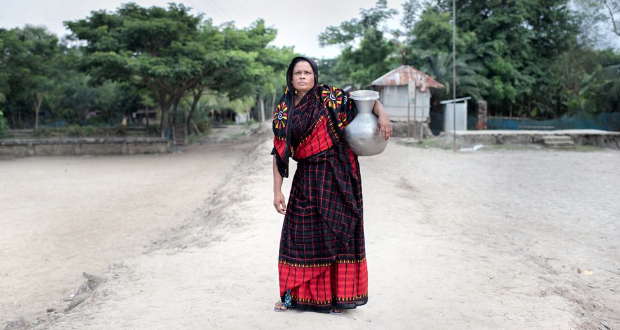
COP26: What climate summit means for one woman in Bangladesh
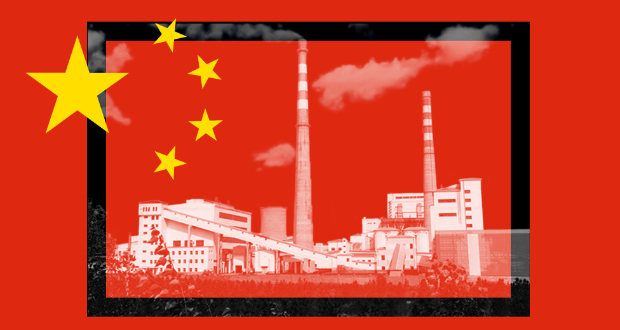
China's carbon emissions are vast and growing, dwarfing those of other countries. Experts agree that without big reductions in China's emissions, the world cannot win the fight against climate change. In 2020, China's President Xi Jinping said his country would aim for its emissions to reach their highest point before 2030 and for carbon neutrality before 2060. His statement has now been confirmed as China's official position ahead of the COP26 global climate summit in Glasgow. But China has not said exactly how these goals will be achieved.
Why China's climate policy matters to us all
China's carbon emissions are vast and growing, dwarfing those of other countries. Experts agree that without big reductions in China's emissions, the world cannot win the fight against climate change. In 2020, China's President Xi Jinping said his country would aim for its emissions to reach their highest point before 2030 and for carbon neutrality before 2060. His statement has now been confirmed as China's official position ahead of the COP26 global climate summit in Glasgow. But China has not said exactly how these goals will be achieved.
Deliver on promises, developing world tells rich at climate talks

A crucial U.N. conference heard calls on its first day for the world's major economies to keep their promises of financial help to address the climate crisis, while big polluters India and Brazil made new commitments to cut emissions. World leaders, environmental experts and activists all pleaded for decisive action to halt the global warming which threatens the future of the planet at the start of the two-week COP26 summit in the Scottish city of Glasgow on Monday. The task facing negotiators was made even more daunting by the failure of the Group of 20 major industrial nations to agree ambitious new commitments at the weekend.