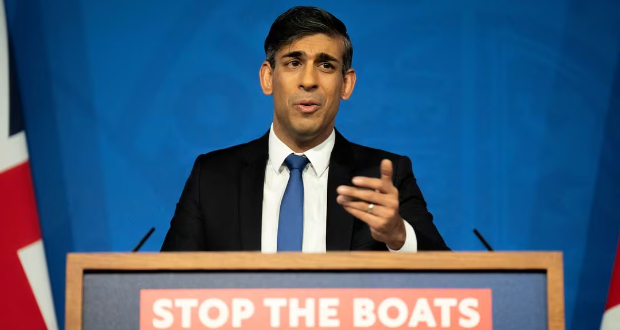
UK's Sunak sees off revolt to win vote on Rwanda migrant plan
British Prime Minister Rishi Sunak avoided defeat in parliament on Tuesday on an emergency bill to revive his plan to send asylum seekers to Rwanda, seeing off a revolt by dozens of his lawmakers that laid bare his party's deep divisions.
Sunak, who has pinned his reputation on the strategy, in the end comfortably won the first vote on the legislation in the House of Commons after a day of last ditch negotiations and fears that some of his Conservative lawmakers would help defeat the bill because it was not tough enough.
"The British people should decide who gets to come to this country – not criminal gangs or foreign courts," Sunak said on X after the result. "That's what this bill delivers."
Last month, the UK Supreme Court ruled Sunak's policy of deporting to Rwanda those arriving illegally in small boats on England's southern coast would breach British and international human rights laws and agreements.
In response, Sunak agreed a new treaty with the East African nation and brought forward emergency legislation designed to override legal obstacles that would stop deportations.
In power for 13 years and trailing the opposition Labour Party by around 20 points with an election expected next year, Sunak's Conservatives have fractured along multiple lines and lost much of their discipline ahead of the first parliamentary vote on that bill.
Moderate Conservatives say they will not support the draft law if it means Britain breaching its human rights obligations, and right-wing politicians say it does not go far enough to stop migrants from making legal challenges to prevent their deportation.
All 350 Conservative lawmakers had been ordered by those in charge of party management to back it, but almost 40 were not recorded as having voted. The bill passed by 313 votes to 269.
"We have decided collectively that we cannot support the bill tonight because of its many omissions," Mark Francois, speaking on behalf of some right-wing Conservative lawmakers, said ahead of the vote.
That group said they would abstain rather than support Sunak, and Francois warned of further rebellions at later stages of the parliamentary process unless the bill was changed to ensure European judges could not block deportation flights as they did in June last year.
"Let's pick this up again in January. We will table amendments and we will take it from there," Francois said.
In a sign of the tensions around the vote, Britain's climate change minister Graham Stuart was called back from the COP28 summit in Dubai to vote in parliament, despite critical negotiations still going on. He left parliament minutes after the vote clutching a bag and was expected to return to Dubai.
Earlier, Sunak was forced to indicate to would-be rebels during a breakfast meeting in Downing Street that he would listen to proposed changes in an attempt to encourage them to back down from a revolt that would have killed the bill.
FURTHER CHALLENGES
Defeat would have been catastrophic for Sunak, severely weakening his authority and raising serious questions about his leadership.
But as well as further attempts from his party's right-wing to toughen the bill, there is likely to be strong opposition in the House of Lords, the unelected upper chamber, to any suggestion of Britain breaching its international obligations.
Governments around the world are also closely watching the outcome as they too grapple with rising migration levels. French lawmakers rejected their immigration bill last night, in a blow to President Emmanuel Macron.
Sunak is Britain's fifth Conservative prime minister in seven years after the vote to leave the European Union polarised politics, leading to repeated bouts of instability.
The Conservatives have repeatedly failed to meet targets to reduce immigration, which has soared even after Brexit stripped EU citizens of the right of free movement, with legal net immigration reaching 745,000 last year.
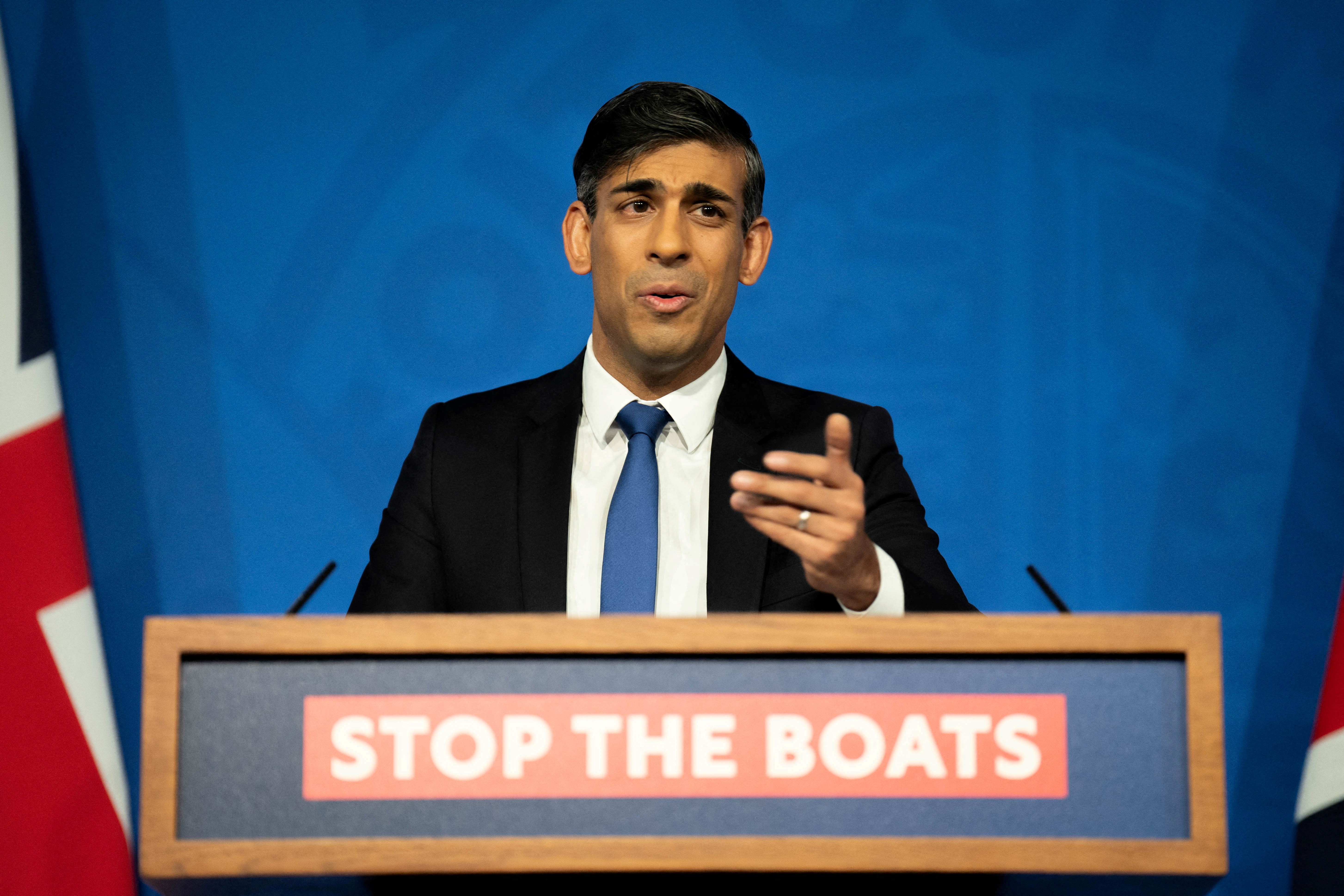
About 29,000 asylum seekers have arrived this year via boats - down around one-third compared with last year - but the sight of inflatable dinghies crossing the Channel remains a highly visible symbol of the government's failure to control Britain's borders - a key promise of Brexit campaigners.
As a result, Sunak has made "stopping the boats" one of five key pledges.
"We will now work to ensure that this bill gets on to the statute book so that we can get flights off to Rwanda and stop the boats," Sunak's spokesperson said after Tuesday's vote.
India targets net-zero carbon emissions by 2070, says Modi
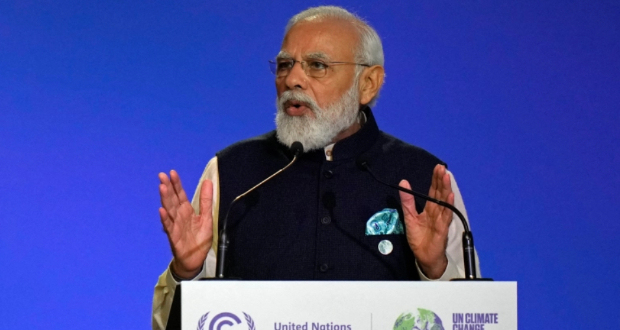
India’s economy will become carbon neutral by the year 2070, the country’s prime minster has announced at the COP26 climate crisis summit in Glasgow. The target date is two decades beyond what scientists say is needed to avert catastrophic climate impacts. India is the last of the world’s major carbon polluters to announce a net-zero target, with China saying it would reach that goal in 2060, and the United States and the European Union aiming for 2050.
COP26: What climate summit means for one woman in Bangladesh

China's carbon emissions are vast and growing, dwarfing those of other countries. Experts agree that without big reductions in China's emissions, the world cannot win the fight against climate change. In 2020, China's President Xi Jinping said his country would aim for its emissions to reach their highest point before 2030 and for carbon neutrality before 2060. His statement has now been confirmed as China's official position ahead of the COP26 global climate summit in Glasgow. But China has not said exactly how these goals will be achieved.
Why China's climate policy matters to us all

China's carbon emissions are vast and growing, dwarfing those of other countries. Experts agree that without big reductions in China's emissions, the world cannot win the fight against climate change. In 2020, China's President Xi Jinping said his country would aim for its emissions to reach their highest point before 2030 and for carbon neutrality before 2060. His statement has now been confirmed as China's official position ahead of the COP26 global climate summit in Glasgow. But China has not said exactly how these goals will be achieved.
Deliver on promises, developing world tells rich at climate talks

A crucial U.N. conference heard calls on its first day for the world's major economies to keep their promises of financial help to address the climate crisis, while big polluters India and Brazil made new commitments to cut emissions. World leaders, environmental experts and activists all pleaded for decisive action to halt the global warming which threatens the future of the planet at the start of the two-week COP26 summit in the Scottish city of Glasgow on Monday. The task facing negotiators was made even more daunting by the failure of the Group of 20 major industrial nations to agree ambitious new commitments at the weekend.