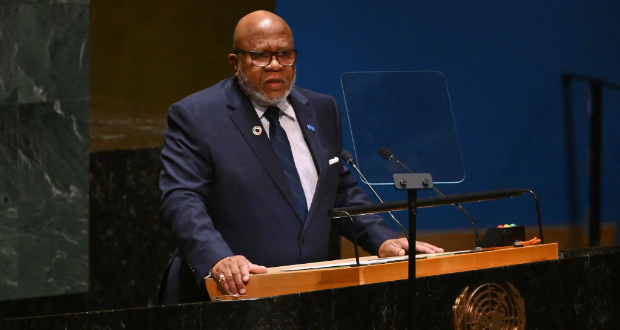
U.N. General Assembly Votes for Israel-Hamas Cease-Fire, Countering U.S. Veto
The U.N. General Assembly demanded an immediate cease-fire in the Israel-Hamas war in an overwhelming vote on Tuesday that highlighted much of the world’s desire to bring the bloody conflict to an end.
About three-quarters of the body’s members voted in favor of the nonbinding resolution, underscoring the isolation of Israel and the United States, which last week blocked a cease-fire resolution in the Security Council.
Resounding applause and cheers erupted after the vote was announced: 153 in favor, 10 against and 23 abstentions. The resolution required two-thirds majority for passage.
“How many more thousands of lives must be lost before we do something?” Dennis Francis, a diplomat from Trinidad and Tobago currently serving as president of the General Assembly, said in an address to the chamber before the vote. “No more time is left. The carnage must stop.”
The resolution was put forth by the U.N.’s Arab Group and the Organization of Islamic Cooperation, which represents Arab and Muslim countries.
More than 15,000 people, many of them women and children, have been killed in Gaza, according to local health officials, since Israel declared war on Hamas after the militant group launched a terrorist attack on Oct. 7, killing more than 1,200 people and taking 240 others hostage.
General Assembly resolutions are never legally binding, but they carry political weight and are a symbolic reflection of the wider perspective among the U.N.’s 193 members.
The countries that joined the U.S. and Israel in rejecting the cease-fire resolution on Tuesday were Austria, the Czech Republic, Guatemala, Liberia, Micronesia, Paraguay and Papua New Guinea and Nauru. Among the countries that abstained were Britain, Hungary, South Sudan and Germany.
Israel’s ambassador to the U.N., Gilad Erdan, sharply criticized the United Nations and said that passing the resolution made the institution more irrelevant. He said that calls for a cease-fire aimed to “tie Israel’s hand and to continue Hamas’s reign of terror.”
The Assembly convened the emergency session after the U.S. vetoed a binding Security Council resolution for a cease-fire on Friday, saying that halting the fighting would allow Hamas to regroup and plan more terrorist attacks similar to the devastating assault on Israel it led from Gaza on Oct. 7.
India targets net-zero carbon emissions by 2070, says Modi
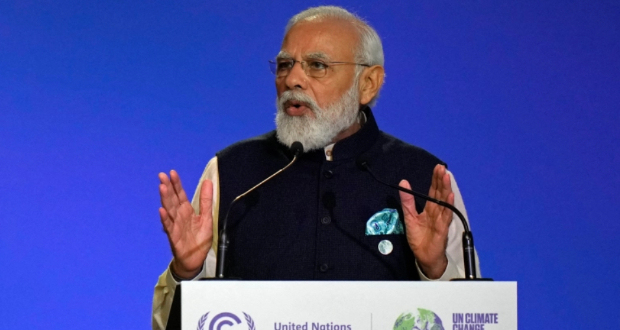
India’s economy will become carbon neutral by the year 2070, the country’s prime minster has announced at the COP26 climate crisis summit in Glasgow. The target date is two decades beyond what scientists say is needed to avert catastrophic climate impacts. India is the last of the world’s major carbon polluters to announce a net-zero target, with China saying it would reach that goal in 2060, and the United States and the European Union aiming for 2050.
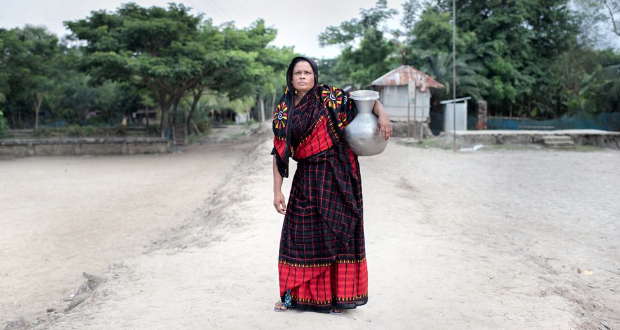
COP26: What climate summit means for one woman in Bangladesh
China's carbon emissions are vast and growing, dwarfing those of other countries. Experts agree that without big reductions in China's emissions, the world cannot win the fight against climate change. In 2020, China's President Xi Jinping said his country would aim for its emissions to reach their highest point before 2030 and for carbon neutrality before 2060. His statement has now been confirmed as China's official position ahead of the COP26 global climate summit in Glasgow. But China has not said exactly how these goals will be achieved.
Why China's climate policy matters to us all
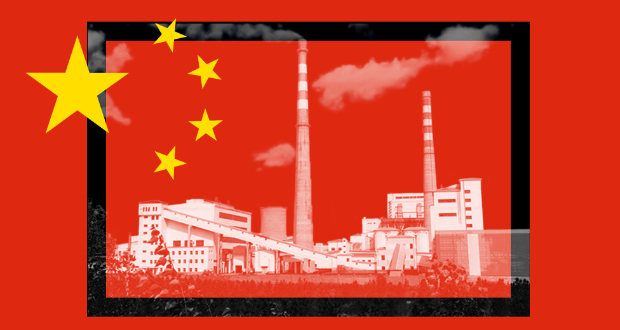
China's carbon emissions are vast and growing, dwarfing those of other countries. Experts agree that without big reductions in China's emissions, the world cannot win the fight against climate change. In 2020, China's President Xi Jinping said his country would aim for its emissions to reach their highest point before 2030 and for carbon neutrality before 2060. His statement has now been confirmed as China's official position ahead of the COP26 global climate summit in Glasgow. But China has not said exactly how these goals will be achieved.
Deliver on promises, developing world tells rich at climate talks

A crucial U.N. conference heard calls on its first day for the world's major economies to keep their promises of financial help to address the climate crisis, while big polluters India and Brazil made new commitments to cut emissions. World leaders, environmental experts and activists all pleaded for decisive action to halt the global warming which threatens the future of the planet at the start of the two-week COP26 summit in the Scottish city of Glasgow on Monday. The task facing negotiators was made even more daunting by the failure of the Group of 20 major industrial nations to agree ambitious new commitments at the weekend.