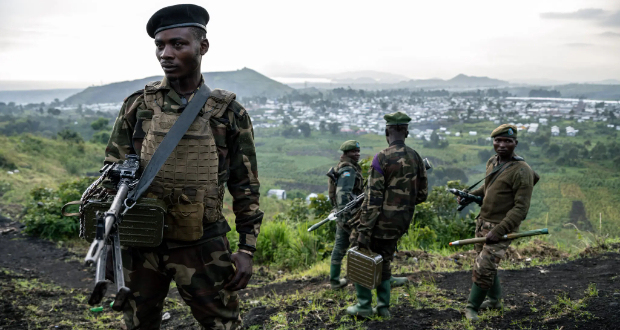
The Overlooked Crisis in Congo: ‘We Live in War’
Artillery boomed, shaking the ground, as a couple scurried through the streets of Saké, their possessions balanced on their heads, in the embattled east of the Democratic Republic of Congo.
At a crossroads, they passed a giant poster of Congo’s president, Felix Tshisekedi, who is standing for re-election on Wednesday. “Unity, Security, Prosperity,” read the slogan. They hurried along.
“Our children were born in war. We live in war,” Jean Bahati, his face beaded with sweat, said as he paused for breath. It was the fifth time that he and his wife had been forced to flee, he said. “We’re so sick of it.”
They joined 6.5 million people displaced by war in eastern Congo, where a conflict that has dragged on for nearly three decades, stoking a vast humanitarian crisis that by some estimates has claimed over six million lives, is now lurching into a volatile new phase.
Making sense of the mayhem is not easy. Over 100 armed groups and several national armies are vying for supremacy across a region of lakes, mountains and rainforests slightly bigger than Florida. Meddlesome foreign powers covet its vast reserves of gold, oil and coltan, a mineral used to make cellphones and electric vehicles. Corruption is endemic. Massacres and rape are common.
For all that, aid groups struggle to draw attention to the suffering in a country of about 100 million people, even when the numbers affected dwarf those of other crises.
“There’s a sense of fatalism about Congo,” said Cynthia Jones, the World Food Program head in eastern Congo. “People seem to think, ‘That’s just the way it is’.”
India targets net-zero carbon emissions by 2070, says Modi
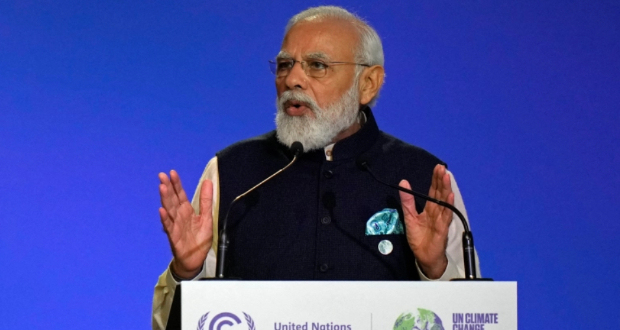
India’s economy will become carbon neutral by the year 2070, the country’s prime minster has announced at the COP26 climate crisis summit in Glasgow. The target date is two decades beyond what scientists say is needed to avert catastrophic climate impacts. India is the last of the world’s major carbon polluters to announce a net-zero target, with China saying it would reach that goal in 2060, and the United States and the European Union aiming for 2050.
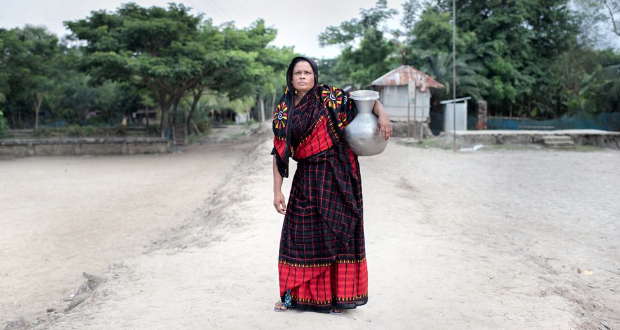
COP26: What climate summit means for one woman in Bangladesh
China's carbon emissions are vast and growing, dwarfing those of other countries. Experts agree that without big reductions in China's emissions, the world cannot win the fight against climate change. In 2020, China's President Xi Jinping said his country would aim for its emissions to reach their highest point before 2030 and for carbon neutrality before 2060. His statement has now been confirmed as China's official position ahead of the COP26 global climate summit in Glasgow. But China has not said exactly how these goals will be achieved.
Why China's climate policy matters to us all
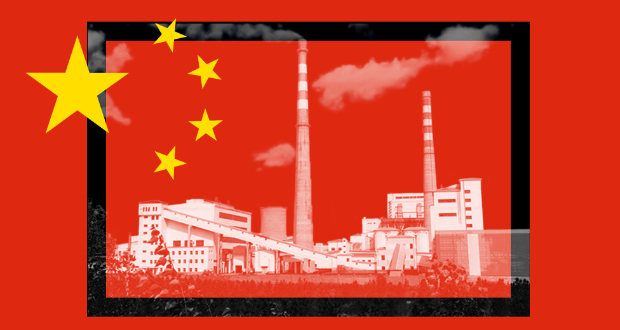
China's carbon emissions are vast and growing, dwarfing those of other countries. Experts agree that without big reductions in China's emissions, the world cannot win the fight against climate change. In 2020, China's President Xi Jinping said his country would aim for its emissions to reach their highest point before 2030 and for carbon neutrality before 2060. His statement has now been confirmed as China's official position ahead of the COP26 global climate summit in Glasgow. But China has not said exactly how these goals will be achieved.
Deliver on promises, developing world tells rich at climate talks

A crucial U.N. conference heard calls on its first day for the world's major economies to keep their promises of financial help to address the climate crisis, while big polluters India and Brazil made new commitments to cut emissions. World leaders, environmental experts and activists all pleaded for decisive action to halt the global warming which threatens the future of the planet at the start of the two-week COP26 summit in the Scottish city of Glasgow on Monday. The task facing negotiators was made even more daunting by the failure of the Group of 20 major industrial nations to agree ambitious new commitments at the weekend.