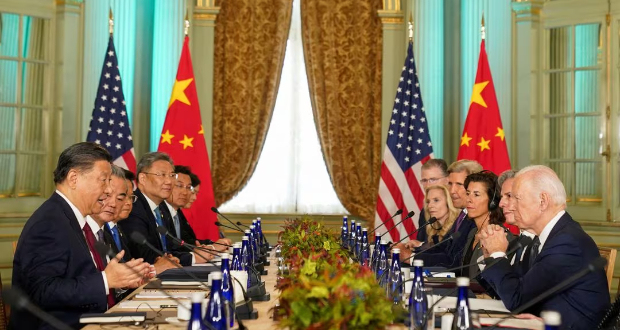
US-China relations: Expect more turbulence in 2024
After a year that brought panic over spy balloons, a fight over semiconductors and an intensifying military rivalry, China and the U.S. are ending the year with an uneasy detente.
This follows a November meeting between U.S. President Joe Biden and Chinese President Xi Jinping where both men signaled a desire to stop the free fall in their countries' relations.
2024 could bring new turbulence. From presidential elections in Taiwan and the U.S. to continued U.S.-China trade fights, Biden and Xi face no shortage of problems that could cause a stumble in the new year.
CROSS-STRAIT TROUBLE
First up will be Taiwan's Jan. 13 presidential and legislative elections. How China reacts could determine whether the relationship between the world’s largest economies becomes recharged with mutual suspicion.
Vice President Lai Ching-te and running mate Hsiao Bi-khim from the ruling Democratic Progressive Party are leading in the polls. China has labeled them as the "independence double-act" and rebuffed Lai's offers of talks.
Elections on the island, which China considers its own territory, have previously escalated tensions, most notably in 1996 when China's military exercises and missile tests ahead of the voting prompted the U.S. to send an aircraft carrier task force to the area.
This time Beijing has again ramped up military and political pressure, framing the elections as a choice between "peace and war," calling the ruling party dangerous separatists and urging Taiwanese to make the "right choice."
Some analysts believe Xi, hoping to avoid conflict, will moderate China's military response if Lai wins. But Taiwan is on high alert for Chinese activities, both military and political, ahead of the election.
TRUMP 2.0?
The 2024 U.S. presidential election could be even more consequential. Barring last-minute surprises, the election will likely be a rematch between Biden and former President Donald Trump.
While the contest is sure to feature heated rhetoric about China, Xi will be more focused on one question: Will Trump return to office?
India targets net-zero carbon emissions by 2070, says Modi
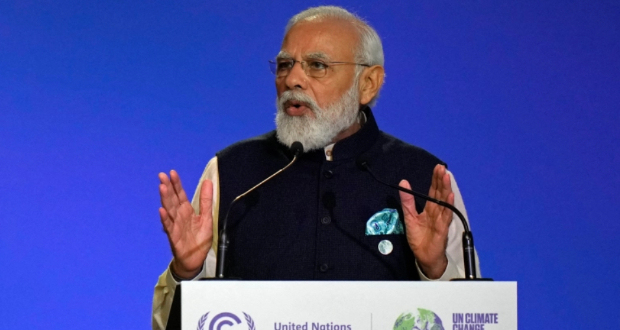
India’s economy will become carbon neutral by the year 2070, the country’s prime minster has announced at the COP26 climate crisis summit in Glasgow. The target date is two decades beyond what scientists say is needed to avert catastrophic climate impacts. India is the last of the world’s major carbon polluters to announce a net-zero target, with China saying it would reach that goal in 2060, and the United States and the European Union aiming for 2050.
COP26: What climate summit means for one woman in Bangladesh

China's carbon emissions are vast and growing, dwarfing those of other countries. Experts agree that without big reductions in China's emissions, the world cannot win the fight against climate change. In 2020, China's President Xi Jinping said his country would aim for its emissions to reach their highest point before 2030 and for carbon neutrality before 2060. His statement has now been confirmed as China's official position ahead of the COP26 global climate summit in Glasgow. But China has not said exactly how these goals will be achieved.
Why China's climate policy matters to us all
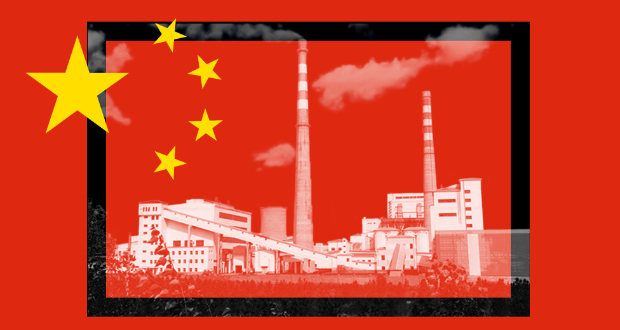
China's carbon emissions are vast and growing, dwarfing those of other countries. Experts agree that without big reductions in China's emissions, the world cannot win the fight against climate change. In 2020, China's President Xi Jinping said his country would aim for its emissions to reach their highest point before 2030 and for carbon neutrality before 2060. His statement has now been confirmed as China's official position ahead of the COP26 global climate summit in Glasgow. But China has not said exactly how these goals will be achieved.
Deliver on promises, developing world tells rich at climate talks

A crucial U.N. conference heard calls on its first day for the world's major economies to keep their promises of financial help to address the climate crisis, while big polluters India and Brazil made new commitments to cut emissions. World leaders, environmental experts and activists all pleaded for decisive action to halt the global warming which threatens the future of the planet at the start of the two-week COP26 summit in the Scottish city of Glasgow on Monday. The task facing negotiators was made even more daunting by the failure of the Group of 20 major industrial nations to agree ambitious new commitments at the weekend.