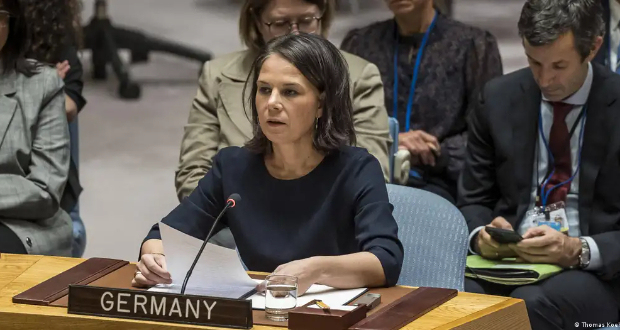
Cease-fire in Gaza: Why Germany abstained in UN votes
Germany's decision to abstain in the October 27 vote at the United Nations General Assembly angered Israel's ambassador in Berlin. Three weeks earlier, Hamas terrorists had brutally attacked Israel, killing hundreds of Israeli soldiers and civilians, and taking many more hostage.
After Israel responded by launching a massive attack on the Gaza Strip, the UN General Assembly passed a resolution calling for a cease-fire to help the people of Gaza. However, the text of the resolution did not address the crimes committed by Hamas. 14 UN member states voted against, including the United States, Israel itself, Hungary, the Czech Republic, and Austria. Germany was one of 45 states that abstained.
Israeli ambassador: "That's not enough!"
"We need Germany's support at the UN," Israel's ambassador to Berlin, Ron Prosor, said afterwards. It wasn't enough, he declared, to abstain "because people are incapable of saying explicitly that Hamas is responsible for this brutal massacre."

That was the reason for the abstention: Germany was not prepared to vote in favor of the resolution because it neither mentioned nor condemned the Hamas terror attacks. But it didn't want to vote against the resolution, either, because that would have shown too little consideration for the suffering of the people of Gaza. Furthermore, Germany will always advocate for a cease-fire in any conflict, on principle.
Germany had worked intensively with Canada to try to improve the text before the vote, adding condemnation of the Hamas attacks and hostage-taking, and calling for the immediate and unconditional release of the hostages. However, this failed to gain the backing of a majority of countries.
Chancellor and foreign office support the abstentions
And the same scenario played out again. On Tuesday, December 12, Germany again abstained at the UN General Assembly in New York. Again, member states were asked to vote on a text that called for a cease-fire, and again Germany voted neither yes nor no.
Its voting behavior was decided on in a close consultation between the Chancellery and the Foreign Office, and many politicians in the Bundestag, from different parties, expressed their approval.
India targets net-zero carbon emissions by 2070, says Modi
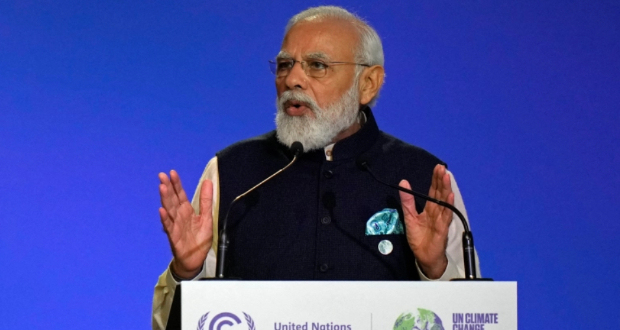
India’s economy will become carbon neutral by the year 2070, the country’s prime minster has announced at the COP26 climate crisis summit in Glasgow. The target date is two decades beyond what scientists say is needed to avert catastrophic climate impacts. India is the last of the world’s major carbon polluters to announce a net-zero target, with China saying it would reach that goal in 2060, and the United States and the European Union aiming for 2050.
COP26: What climate summit means for one woman in Bangladesh

China's carbon emissions are vast and growing, dwarfing those of other countries. Experts agree that without big reductions in China's emissions, the world cannot win the fight against climate change. In 2020, China's President Xi Jinping said his country would aim for its emissions to reach their highest point before 2030 and for carbon neutrality before 2060. His statement has now been confirmed as China's official position ahead of the COP26 global climate summit in Glasgow. But China has not said exactly how these goals will be achieved.
Why China's climate policy matters to us all
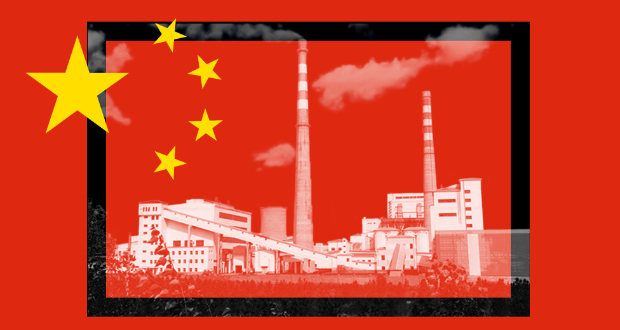
China's carbon emissions are vast and growing, dwarfing those of other countries. Experts agree that without big reductions in China's emissions, the world cannot win the fight against climate change. In 2020, China's President Xi Jinping said his country would aim for its emissions to reach their highest point before 2030 and for carbon neutrality before 2060. His statement has now been confirmed as China's official position ahead of the COP26 global climate summit in Glasgow. But China has not said exactly how these goals will be achieved.
Deliver on promises, developing world tells rich at climate talks

A crucial U.N. conference heard calls on its first day for the world's major economies to keep their promises of financial help to address the climate crisis, while big polluters India and Brazil made new commitments to cut emissions. World leaders, environmental experts and activists all pleaded for decisive action to halt the global warming which threatens the future of the planet at the start of the two-week COP26 summit in the Scottish city of Glasgow on Monday. The task facing negotiators was made even more daunting by the failure of the Group of 20 major industrial nations to agree ambitious new commitments at the weekend.