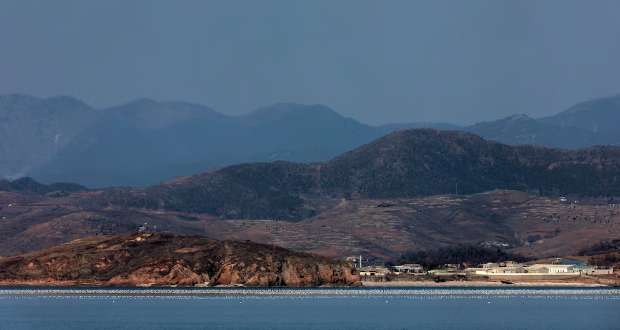
North Korea again fires near the sea border with the South, as its leader's sister mocks Seoul
North Korea again fired artillery shells near its tense sea boundary with the South on Sunday, as the influential sister of North Korean leader Kim Jong Un mocked the South's ability to detect its weapons launches.
South Korea’s Joint Chiefs of Staff dismissed Kim Yo Jong’s statement as “a comedy-like, vulgar propaganda” meant to undermine the South Korean people’s trust in the military and stoke divisions.
The Joint Chiefs of Staff said North Korea fired more than more than 90 rounds near the rivals’ disputed western sea boundary on Sunday afternoon. It said South Korea strongly urged North Korea to stop provocative acts immediately.
North Korea’s military later confirmed it used coastal artillery systems to carry out live-firing exercises. It said the drills were part of its military training schedules and the direction of its shells fired didn’t expose any threat to South Korea.
On Friday, North Korea launched about 200 shells. South Korea also claimed that the North fired more than 60 rounds on Saturday, but its rival has denied that.
Kim Yo Jong said that North Korea on Saturday only detonated blasting powder simulating the sound of its coastal artillery on the seashore, to test the South Korean military’s detection capabilities.
“The result was clear as we expected. They misjudged the blasting sound as the sound of gunfire and conjectured it as a provocation. And they even made a false and impudent statement that the shells dropped north” of the sea boundary, Kim Yo Jong said in a statement carried by state media.
“I cannot but say that (South Korean) people are very pitiful as they entrust security to such blind persons and offer huge taxes to them,” she said. “It is better 10 times to entrust security to a dog with a developed sense of hearing and smell.”
Animosities between the two Koreas are running high because North Korea has conducted a barrage of missile tests since 2022 while South Korea has expanded its military training with the United States in a tit-for-tat cycle.
North Korea’s artillery firings Friday prompted South Korea to have its troops on border islands fire artillery rounds near the sea boundary in response. The shells launched by the two Koreas fell at a maritime buffer zone they had established under a 2018 military agreement on lowering front-line military tensions.
India targets net-zero carbon emissions by 2070, says Modi
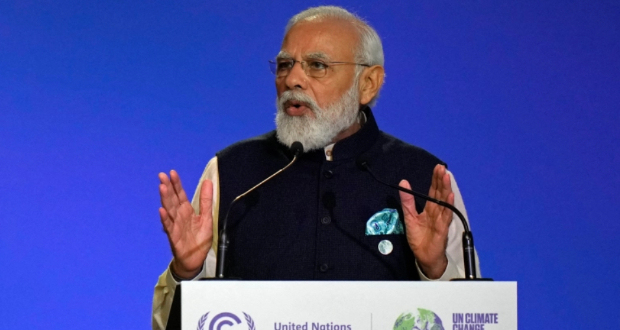
India’s economy will become carbon neutral by the year 2070, the country’s prime minster has announced at the COP26 climate crisis summit in Glasgow. The target date is two decades beyond what scientists say is needed to avert catastrophic climate impacts. India is the last of the world’s major carbon polluters to announce a net-zero target, with China saying it would reach that goal in 2060, and the United States and the European Union aiming for 2050.
COP26: What climate summit means for one woman in Bangladesh

China's carbon emissions are vast and growing, dwarfing those of other countries. Experts agree that without big reductions in China's emissions, the world cannot win the fight against climate change. In 2020, China's President Xi Jinping said his country would aim for its emissions to reach their highest point before 2030 and for carbon neutrality before 2060. His statement has now been confirmed as China's official position ahead of the COP26 global climate summit in Glasgow. But China has not said exactly how these goals will be achieved.
Why China's climate policy matters to us all
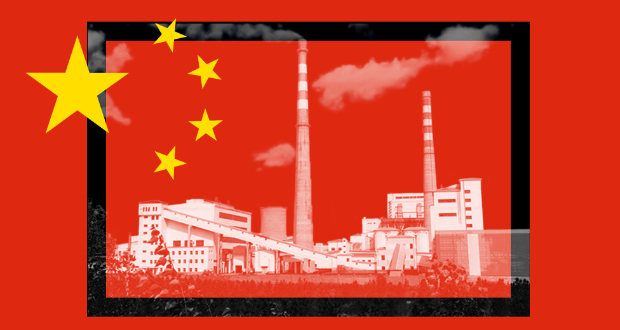
China's carbon emissions are vast and growing, dwarfing those of other countries. Experts agree that without big reductions in China's emissions, the world cannot win the fight against climate change. In 2020, China's President Xi Jinping said his country would aim for its emissions to reach their highest point before 2030 and for carbon neutrality before 2060. His statement has now been confirmed as China's official position ahead of the COP26 global climate summit in Glasgow. But China has not said exactly how these goals will be achieved.
Deliver on promises, developing world tells rich at climate talks

A crucial U.N. conference heard calls on its first day for the world's major economies to keep their promises of financial help to address the climate crisis, while big polluters India and Brazil made new commitments to cut emissions. World leaders, environmental experts and activists all pleaded for decisive action to halt the global warming which threatens the future of the planet at the start of the two-week COP26 summit in the Scottish city of Glasgow on Monday. The task facing negotiators was made even more daunting by the failure of the Group of 20 major industrial nations to agree ambitious new commitments at the weekend.