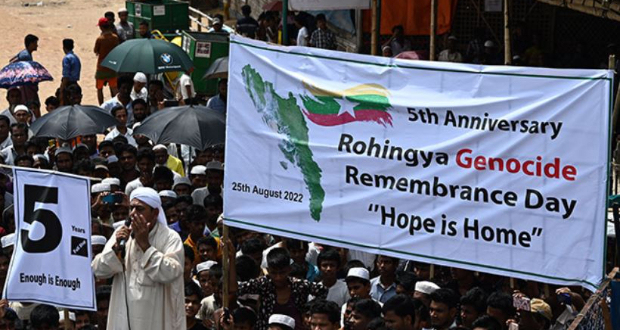
5 years in exile: What lies ahead for the displaced Rohingyas?
On 25 August, the exodus of close to a million Rohingyas to Bangladesh brought on by the rising violence in Myanmar’s Rakhine State, marked its fifth year. In 2017, the Rohingya people were driven out of Myanmar, which was acknowledged as ethnic cleansing and even genocide by the international world. Officials from the United Nations (UN) have stated that the country’s military leaders should be held accountable for the worst crimes against humanity. However, the conditions of these displaced people living in the peripheries have only worsened. The displaced Rohingyas residing in the camps in Bangladesh are referred to as Forcibly Displaced Myanmar Nationals (FDMN). The FDMNs are individuals without a state and aren’t considered as citizens in Myanmar or refugees in Bangladesh, since the nation is not a signatory to the 1951 Refugee Convention. The future course of action for the repatriation of the FDMNs looks dismal in the domestic run-offs in both, coup-torn Myanmar and the election-awaiting Bangladesh. Bangladesh, a lower-middle-class country, currently experiencing economic constraints has provided around 918,814 refugees sanctuary in the Cox’s Bazar district and Bhasan Char Island. The Cox’s Bazar has grown to be the biggest refugee colony in the world since 2017. The flood of new immigrants has placed a great strain on the already limited facilities and transitory settlements that have been further exacerbated by the COVID-19 pandemic and ever-evolving climate change. The perils of fires during the dry season followed by landslides, and flooding in the monsoons have increased. By March 2022, six fire incidents were reported, causing damage to life and property. The torrential rain and landslides, since the beginning of the monsoon season in 2022, have affected more than 13,000 shelters including learning centres, and WASH points. The Bangladesh government along with humanitarian partners including UNHCR, IOM, UNICEF, WHO, and WFP has been responding to these incidences by providing prompt life assistance to the people in need, and also by strengthening the response and coordination teams through the building of two-story shelters with space for fire breaks, conducting capacity building and mock drills. Several volunteers have also been recruited from the displaced population to fortify action points and redressal mechanisms.
India targets net-zero carbon emissions by 2070, says Modi
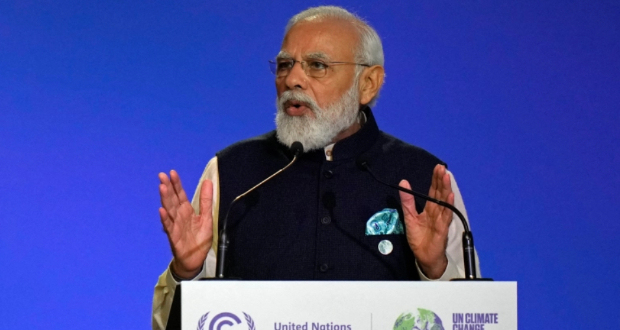
India’s economy will become carbon neutral by the year 2070, the country’s prime minster has announced at the COP26 climate crisis summit in Glasgow. The target date is two decades beyond what scientists say is needed to avert catastrophic climate impacts. India is the last of the world’s major carbon polluters to announce a net-zero target, with China saying it would reach that goal in 2060, and the United States and the European Union aiming for 2050.
COP26: What climate summit means for one woman in Bangladesh
China's carbon emissions are vast and growing, dwarfing those of other countries. Experts agree that without big reductions in China's emissions, the world cannot win the fight against climate change. In 2020, China's President Xi Jinping said his country would aim for its emissions to reach their highest point before 2030 and for carbon neutrality before 2060. His statement has now been confirmed as China's official position ahead of the COP26 global climate summit in Glasgow. But China has not said exactly how these goals will be achieved.
Why China's climate policy matters to us all
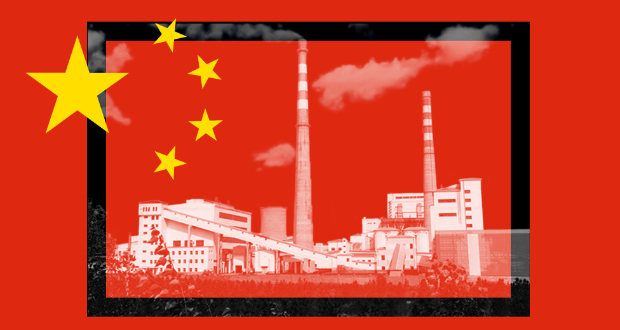
China's carbon emissions are vast and growing, dwarfing those of other countries. Experts agree that without big reductions in China's emissions, the world cannot win the fight against climate change. In 2020, China's President Xi Jinping said his country would aim for its emissions to reach their highest point before 2030 and for carbon neutrality before 2060. His statement has now been confirmed as China's official position ahead of the COP26 global climate summit in Glasgow. But China has not said exactly how these goals will be achieved.
Deliver on promises, developing world tells rich at climate talks

A crucial U.N. conference heard calls on its first day for the world's major economies to keep their promises of financial help to address the climate crisis, while big polluters India and Brazil made new commitments to cut emissions. World leaders, environmental experts and activists all pleaded for decisive action to halt the global warming which threatens the future of the planet at the start of the two-week COP26 summit in the Scottish city of Glasgow on Monday. The task facing negotiators was made even more daunting by the failure of the Group of 20 major industrial nations to agree ambitious new commitments at the weekend.